
For anyone using or partnering with a crypto exchange in Europe, the question is no longer simply whether the platform says it is “regulated”. Under the Markets in Crypto-Assets Regulation (MiCA), the relevant question is which legal entity serves European clients, whether that entity is authorized to provide crypto-asset services, and exactly which services its authorization covers.
That distinction became particularly important in 2026. MiCA's transitional arrangements allowed some providers that were already operating under national regimes to continue temporarily, but the EU-wide transitional period ended on 1 July 2026. ESMA has confirmed that entities providing crypto-asset services to EU clients after that date need an appropriate MiCA authorization or another permitted authorization route.
This article provides a practical 2026 snapshot of major MiCA-licensed exchanges and explains how to verify a platform properly. Because regulatory registers change, the live ESMA MiCA Register should always take precedence over any static list.
Register status checked: ESMA register update published 21 August 2026.
What does “MiCA-licensed exchange” actually mean?
“MiCA license” is the market shorthand for authorization to provide crypto-asset services under Regulation (EU) 2023/1114. Under Article 59 of MiCA, a company generally cannot provide regulated crypto-asset services in the EU unless it has been authorized as a Crypto-Asset Service Provider, or CASP, under Article 63, or is an already regulated financial entity permitted to provide specified crypto services through the Article 60 notification route.
This matters because a familiar exchange brand is not itself the authorization holder. The license belongs to a specific legal entity. Coinbase, for example, operates its relevant MiCA authorization through Coinbase Luxembourg S.A.; Kraken through Payward Europe Solutions Limited; and Crypto.com through Foris DAX MT Limited. The legal entity, rather than the global brand, is what should be checked in the register.
MiCA authorization is also service-specific. A CASP may be authorized for custody, exchange, execution of orders and transfer services without necessarily being authorized to operate a trading platform. Another provider may have a wider authorization. A logo saying “MiCA compliant” therefore tells only part of the story.
Which crypto exchanges have a MiCA license in 2026?
The authoritative source is the ESMA MiCA Register. Under Article 109, ESMA maintains the central record of authorized crypto-asset service providers using information supplied by national competent authorities. The register records the legal entity and authorization information and is updated regularly.
The table below focuses on major consumer-facing crypto platforms rather than every CASP in the register. The ESMA database is considerably broader and also includes custodians, brokers, fintech companies, banks and other crypto service providers.
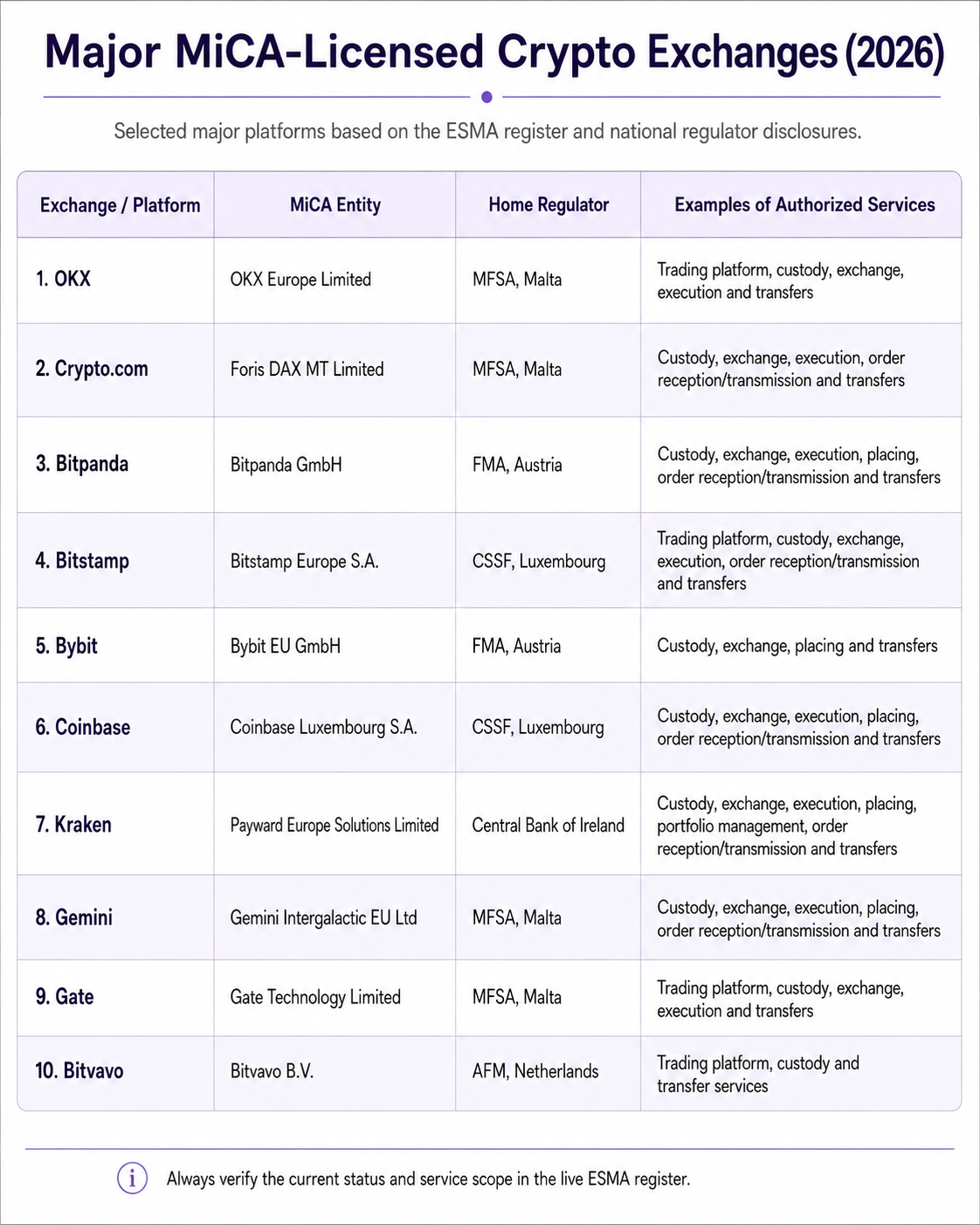
Important: This is a selected snapshot, not an exhaustive list. Always verify the exact legal entity and current service scope in ESMA’s live register before relying on a platform’s status.
Does a MiCA license cover every service an exchange offers?
No. MiCA separates crypto-asset services into defined regulatory activities. These include custody and administration, operation of a trading platform, exchange of crypto-assets for funds, crypto-to-crypto exchange, execution of orders, placing, reception and transmission of orders, advice, portfolio management and transfer services.
An authorization specifies which of those activities a particular CASP may provide. Article 59 expressly requires competent authorities to ensure that authorizations specify the crypto-asset services covered. This creates differences that are easy to miss when comparing brands.
For example, Bitstamp Europe S.A. is authorized to operate a trading platform in addition to custody, exchange, execution and transfer services. Bybit EU GmbH has a different published authorization scope covering custody, exchange, placing and transfers. That does not make one authorization inherently “better” than another. It means the regulatory perimeter needs to match the service being provided.
For founders choosing an exchange for a token listing, businesses selecting a custody partner or counterparties conducting due diligence, checking only whether a platform has “a MiCA license” is therefore insufficient.
How does the law apply to a MiCA-licensed exchange?
MiCA authorization is not a one-time badge. A CASP authorized under Article 63 must continue meeting the conditions of its authorization. Depending on its activities, MiCA imposes requirements relating to governance, prudential safeguards, safeguarding of client assets, conflicts of interest, complaints handling, outsourcing and conduct of business.
For custody specifically, MiCA requires contractual and operational arrangements addressing the custody service, custody policy, authentication, security systems, fees and applicable law. The authorization scope also affects prudential safeguards and the minimum permanent capital applicable to the provider.
A MiCA authorization should therefore be understood as a regulated operating perimeter, not simply as permission to market a crypto business in Europe.
Legal expert insight - Peter Merc, founder of Lemur Legal “A MiCA license belongs to a legal entity, not to a brand. The same exchange may operate through several companies across different jurisdictions, and those entities do not necessarily have the same regulatory status or authorization scope. Before relying on a platform’s ‘MiCA licensed’ claim, businesses should verify which EU entity they are actually contracting with, whether it is authorized under Article 63 or operating through another permitted route, and whether its authorization covers the specific service they intend to use.”
For the authorization process itself, see MiCA License: How to Get Authorized as a CASP in the EU.
How can you check whether an exchange is really MiCA-licensed?
The safest verification process starts with the exchange’s European legal entity, not its commercial name. Look at the platform’s terms of service or regulatory disclosures and identify the entity contractually serving customers in your country.
Then search that legal entity in the ESMA MiCA Register. ESMA explains that the register is updated at regular intervals using information supplied by competent authorities, so a national register may occasionally reflect a change before the central register does.
Finally, compare the ESMA entry with the relevant national competent authority where useful. National regulator records can provide a clear service-by-service view of the authorization and passporting position.
Legal entity: Is the company in the register actually the company serving your account?
Authorization status: Is it currently authorized under MiCA, rather than relying on a legacy national VASP registration?
Service scope: Does the authorization cover the particular activity you are relying on?
This process is more reliable than a general “regulated in Europe” statement on a marketing page.
What happened after the MiCA transition deadline?
The 2026 register matters because the regulatory landscape changed materially when the transitional period ended. ESMA’s April 2026 statement confirms that the MiCA transitional period expired across the EU on 1 July 2026 and that entities continuing to provide crypto-asset services to EU clients without the required authorization must cease those services.
ESMA also reminded consumers in June 2026 to verify whether their provider is authorized under MiCA in the ESMA register. This is an important distinction because an old national VASP registration should not be treated as equivalent to current MiCA authorization after the applicable transitional period has ended.
The register remains dynamic. New authorizations, changes of scope and withdrawals can alter a platform’s regulatory position, which is why a static article should be used as a starting point rather than as a substitute for the live regulatory record.
Does MiCA authorization mean an exchange is safe?
No regulatory license can eliminate investment, custody, operational or market risk. MiCA authorization means that a provider has entered a defined regulatory framework and must comply with applicable authorization and ongoing conduct requirements. It does not mean that a regulator guarantees the exchange, its financial performance, the value of crypto-assets listed on it or that losses are impossible.
For users, the register is therefore a regulatory due-diligence tool. For token issuers and businesses, it is also useful when selecting listing venues, custody providers and other crypto counterparties. In higher-stakes situations, the relevant questions may extend beyond MiCA status to the exchange’s precise legal entity, contractual terms, custody model, jurisdiction and the regulatory classification of the asset concerned.
Check the entity, not just the logo
The answer to “which crypto exchanges have a MiCA license?” is now easier to verify than it was during Europe’s fragmented VASP era. Major platforms including Coinbase, Kraken, OKX, Crypto.com, Bitpanda, Bitstamp, Bybit, Gemini, Gate and Bitvavo operate through entities that hold MiCA authorizations.
But the useful question goes one step further: which entity is authorized, by which regulator, for which services, and does that entity actually serve you? The ESMA MiCA Register should remain the first point of verification because it provides the EU-wide regulatory record and is updated as competent authorities submit changes.
For businesses making listing, custody or market-entry decisions, Lemur Legal can assess the regulatory perimeter and how a particular CASP relationship fits into the wider MiCA compliance framework.