

Launching a stablecoin in Europe is no longer simply a question of creating a token and maintaining its peg. Under the EU's Markets in Crypto-Assets Regulation (MiCA), the legal structure behind a stablecoin matters just as much as its technical design. Founders must determine which regulatory category applies, what type of authorization is required and whether their business can support the obligations that continue long after the token enters circulation.
A token backed by euros may look commercially similar to one backed by a basket of currencies, yet the two can fall under different regulatory regimes. MiCA distinguishes between e-money tokens (EMTs) and asset-referenced tokens (ARTs), with separate requirements concerning issuer eligibility, reserves, redemption rights and governance. Understanding these differences is essential before finalizing tokenomics, selecting an issuing entity or committing to a launch schedule.
What Are Stablecoins Under MiCA?
Stablecoins are crypto-assets designed to maintain a relatively stable value, usually by referencing an external asset, currency or combination of assets. They are widely used for payments, settlement, trading and transferring value between financial platforms. However, the term stablecoin is a commercial description rather than a standalone legal classification under MiCA.
Under Regulation (EU) 2023/1114, stablecoins within the regulation's scope generally fall into two categories: e-money tokens and asset-referenced tokens. Their classification depends on the token's actual characteristics, the value it references and the rights attached to it, rather than how the issuer describes the product.
E-Money Tokens (EMTs)
An e-money token is a crypto-asset that purports to maintain a stable value by referencing the value of one official currency. A euro-referenced token, for example, would generally fall within the EMT framework if it satisfies the relevant legal definition.
MiCA treats EMTs as electronic money, connecting their issuance to the established European regulatory framework for electronic money institutions and credit institutions. This has significant implications for who may issue an EMT, how funds received from holders must be safeguarded and what redemption rights token holders possess.
Asset-Referenced Tokens (ARTs)
An asset-referenced token seeks to maintain a stable value by referencing another value or right, or a combination of values or rights, including one or more official currencies. A token referencing a basket of currencies or other assets may fall within this category, depending on its specific design.
ARTs are subject to a dedicated regulatory regime under MiCA, including authorization requirements, reserve-of-assets obligations and governance standards. Unlike EMTs, which reference a single official currency, ARTs may involve more complex reference mechanisms, making their legal and operational assessment particularly important.
EMT vs ART: What Is the Difference?
Although both categories are designed around value stability, MiCA approaches their issuance differently. The distinction affects the issuer's regulatory status, reserve arrangements, redemption obligations and ongoing supervisory responsibilities.
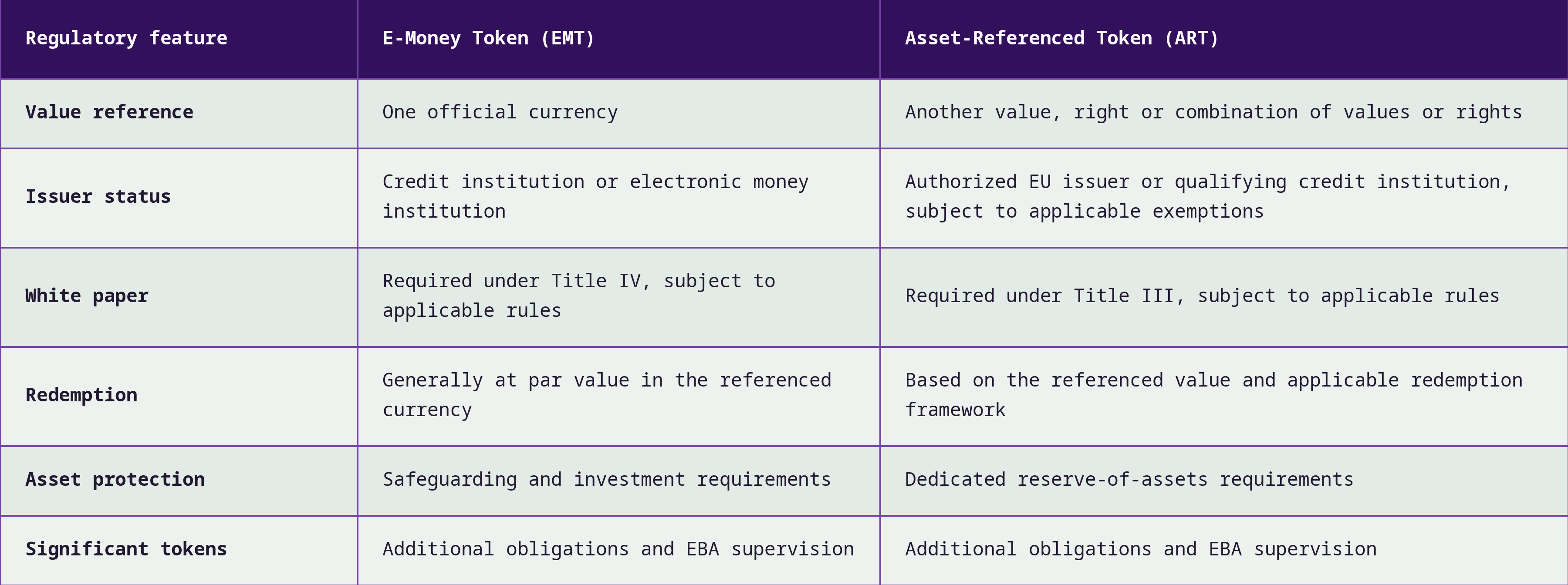
One particularly important difference concerns redemption. Under Article 49 of MiCA, an EMT holder has a claim against the issuer and may request redemption at any time and at par value, subject to the applicable provisions. For ARTs, Article 39 establishes redemption rights linked to the referenced assets or values, with specific requirements governing how redemption operates.
These differences have direct commercial consequences. An issuer must consider not only how the token maintains its intended value, but also whether its corporate structure, treasury arrangements and financial resources can meet the requirements of the applicable regulatory category.
How Do MiCA Stablecoin Issuer Obligations Work in Practice?
Stablecoin compliance is an ongoing responsibility rather than a document submitted before launch. Both EMT and ART issuers must establish appropriate legal, organizational and financial arrangements, although the exact requirements differ according to the token's classification.
Authorization and Issuer Structure
An EMT issuer must generally already be authorized as an electronic money institution or credit institution before offering the token to the public or seeking its admission to trading in the EU. An ART issuer generally requires authorization under MiCA unless it qualifies through the credit-institution route or a specific statutory exemption.
Incorporating an entity in an EU Member State does not automatically provide permission to issue either category of token. Founders must consider the issuer's legal status, the competent supervisory authority, the proposed business model and whether the entity can satisfy the relevant regulatory requirements.
Reserves and Safeguarding
For ARTs, MiCA requires issuers to establish and maintain a reserve of assets, with rules covering composition, segregation, custody and liquidity. EMT issuers operate under a different framework that combines electronic-money safeguarding obligations with MiCA-specific requirements concerning funds received in exchange for tokens.
These arrangements influence the issuer's banking relationships, treasury operations and ability to meet redemption requests. A stablecoin may have technically reliable smart contracts and a well-designed stabilization mechanism but still face serious regulatory difficulties if the underlying reserve or safeguarding arrangements are inadequate.
Governance and Operational Controls
Stablecoin issuers must also address governance, internal controls, risk management, complaints handling and operational continuity. Depending on their regulatory status and activities, additional obligations may arise under other financial-sector legislation, including the Digital Operational Resilience Act (DORA).
This means that stablecoin compliance extends well beyond the token itself. It affects the issuer's corporate structure, contractual relationships, banking arrangements, internal responsibilities and technology infrastructure. These considerations should therefore form part of the initial business design rather than being addressed immediately before launch.
Do Stablecoin Issuers Need Separate MiCA Authorization?
The answer depends primarily on whether the token qualifies as an EMT or ART and on the issuer's existing regulatory status. Under Article 48 of MiCA, EMT issuance generally requires the issuer to be authorized as an electronic money institution or credit institution. A standard crypto-asset service provider (CASP) authorization is not sufficient to issue EMTs.
For ARTs, Article 16 establishes a dedicated authorization regime, while Article 17 provides a specific route for credit institutions. MiCA also contains limited exemptions from ART authorization, including certain smaller-scale issuances and offerings restricted to qualified investors. However, these exemptions are subject to conditions and do not necessarily remove other regulatory obligations, including requirements relating to documentation or disclosure.
A separate question arises when an exchange or another CASP intends to list or provide services involving an existing stablecoin. CASP authorization does not automatically permit the distribution of every stablecoin in the EU. Service providers must assess the token's regulatory status, the issuer's eligibility and the legality of the proposed activities. ESMA addressed these issues in its January 2025 guidance concerning non-compliant ARTs and EMTs.
Legal Insight | Dr. Peter Merc, founder, Lemur Legal
“One of the biggest mistakes in stablecoin projects is treating legal classification as something to address after the tokenomics have been finalized. Under MiCA, the distinction between an EMT and an ART can determine the entire regulatory structure, from who is allowed to issue the token to how reserves and redemption rights must be managed.
Getting this wrong early can mean redesigning a product that is already technically ready to launch. That is why regulatory classification should be one of the first decisions, not one of the last.”
A defensible legal assessment must consider the token's actual characteristics, the issuer's business model, the relevant jurisdiction and the proposed distribution arrangements. Where the classification is uncertain, a formal legal opinion may be necessary to establish a documented and reasoned regulatory position.
What Must an Issuer Prepare Before Launch?
A compliant stablecoin launch requires considerably more than publishing tokenomics or commissioning a smart-contract audit. The issuer should begin with a documented legal classification, followed by an assessment of its regulatory eligibility, the proposed reserve or safeguarding arrangements and the rights granted to token holders.
Regulatory documentation is another important component. Depending on the token category, this may include a MiCA white paper, authorization materials, notifications, internal policies and supporting evidence. These documents must accurately describe the business model and should remain consistent with the issuer's contractual arrangements and actual operations.
Operational readiness is equally important. Founders should assess governance arrangements, ICT risks, outsourcing relationships, banking dependencies and incident-response procedures before committing to a public launch. They should also establish whether trading platforms and other intermediaries may lawfully make the token available in the intended markets.
The European Banking Authority's MiCA supervisory framework highlights additional requirements that can apply when ARTs or EMTs are classified as significant. For issuers expecting substantial adoption, this is an important planning consideration because a structure that is manageable at launch may require additional capital, liquidity and supervisory arrangements as the project grows.
Which Stablecoins Are MiCA-Compliant?
There is no reliable shortcut for determining compliance based solely on a stablecoin's name, popularity, collateralization claims or availability on a particular exchange. A proper assessment requires examining the issuer, the token's legal classification, its regulatory status and the conditions under which it is offered or admitted to trading in the EU.
The ESMA MiCA register provides an important starting point for checking regulatory information concerning ART and EMT issuers. However, a register entry should be interpreted in context and does not replace a review of the relevant authorizations, token documentation or current regulatory circumstances.
For businesses considering integrating a third-party stablecoin, the assessment should establish who is legally responsible for issuance, whether the issuer has the necessary regulatory status and whether the token's documentation accurately reflects its economic structure. Redemption rights, operational restrictions and intended distribution arrangements should also be reviewed.
These questions matter not only to issuers but also to exchanges, payment businesses and fintech platforms that rely on stablecoins as part of their services.
Common Stablecoin Compliance Mistakes
One of the most common misconceptions is that full collateralization automatically means regulatory compliance. A stablecoin can be fully backed from an economic perspective while lacking the required authorization, documentation or governance arrangements. Similarly, publishing a MiCA white paper does not replace the need for an authorization where the law requires one.
Another mistake is selecting a jurisdiction primarily on the assumption that authorization will be faster or easier. In practice, supervisory expectations, banking access, local substance requirements and the issuer's operational capacity may be more important than the perceived speed of the application process.
Founders should also exercise particular care when incorporating rewards or yield mechanisms into tokenomics. MiCA restricts the granting of interest in relation to ARTs and EMTs, meaning that a proposed incentive arrangement should be legally assessed before being included in the product or its marketing materials.
Ultimately, technical stability, financial backing and regulatory compliance are connected but distinct considerations. A sustainable stablecoin project must address all three.
Building a Stablecoin That Can Operate Legally
MiCA has made stablecoin issuance in Europe a more structured financial-services activity. For founders, the critical decision is not simply whether to issue an EMT or ART, but whether the proposed token, issuer and operating model can satisfy the regulatory requirements attached to that classification.
Getting the structure right early can prevent expensive changes to tokenomics, contractual arrangements and reserve management immediately before launch. It can also provide greater clarity when engaging with banks, trading platforms, investors and supervisory authorities.
Lemur Legal works with crypto and fintech businesses on crypto legal opinions and MiCA-compliant white papers. These services are particularly relevant when a project needs to establish whether its stablecoin model is legally viable before committing substantial development resources.
A sound stablecoin strategy begins with a defensible regulatory foundation, not the assumption that technical stability alone is enough.
This article provides general information and does not constitute legal advice. The applicable obligations depend on the token structure, issuer status, jurisdiction and current regulatory requirements.