

For a deep-tech startup, developing a promising technology is only one part of building a commercially viable business. Access to specialist testing facilities, industrial partners, research infrastructure, potential customers and patient capital can be equally important. For companies developing defence and dual-use technologies, these challenges are often accompanied by additional regulatory, contractual and security requirements.
Europe offers an increasingly diverse ecosystem of accelerators, incubators and innovation funding programmes designed to address these challenges. NATO DIANA, the EUDIS Defence Business Accelerator, the EIC Accelerator and research-oriented incubators each support different stages of technology development and commercialisation. However, choosing the right programme requires more than comparing funding amounts or the reputation of the organisation behind it. The most suitable accelerator is the one that matches the company's technology maturity, commercial objectives, validation needs and regulatory position without creating unnecessary restrictions on its intellectual property or future growth.
This guide compares the principal European accelerator and incubation opportunities, explains how founders can prepare competitive applications and identifies the legal issues that deserve attention before joining a programme.
What is the difference between an accelerator, an incubator and an innovation funding programme?
Although these terms are frequently used interchangeably, they describe different forms of startup support. An incubator generally helps early-stage companies establish the foundations of their business through access to research infrastructure, laboratories, university networks, business development expertise and assistance with commercialising scientific research. An accelerator typically provides a more structured and time-limited programme focused on achieving specific development or commercial milestones, often combining mentoring, technical validation, customer introductions and financial assistance.
Innovation funding programmes primarily provide financial support for research, development, demonstration or commercial scale-up. They may incorporate business acceleration services, but their principal function is not necessarily the same as that of a conventional accelerator.
For deep-tech founders, this distinction is particularly important because technological and commercial maturity do not always develop at the same pace. A company may have a technically advanced prototype but limited customer validation, while another may have considerable market interest but still require access to specialist testing facilities. The most appropriate support mechanism therefore depends on the specific obstacle preventing the company from reaching its next development milestone.
Which European accelerators are most relevant for deep-tech and defence startups?
European technology founders can access several established programmes supporting different stages of innovation, from research commercialisation to defence-market validation and international scale-up. The following comparison provides an overview of four prominent routes, their primary objectives and the types of companies for which they may be relevant.
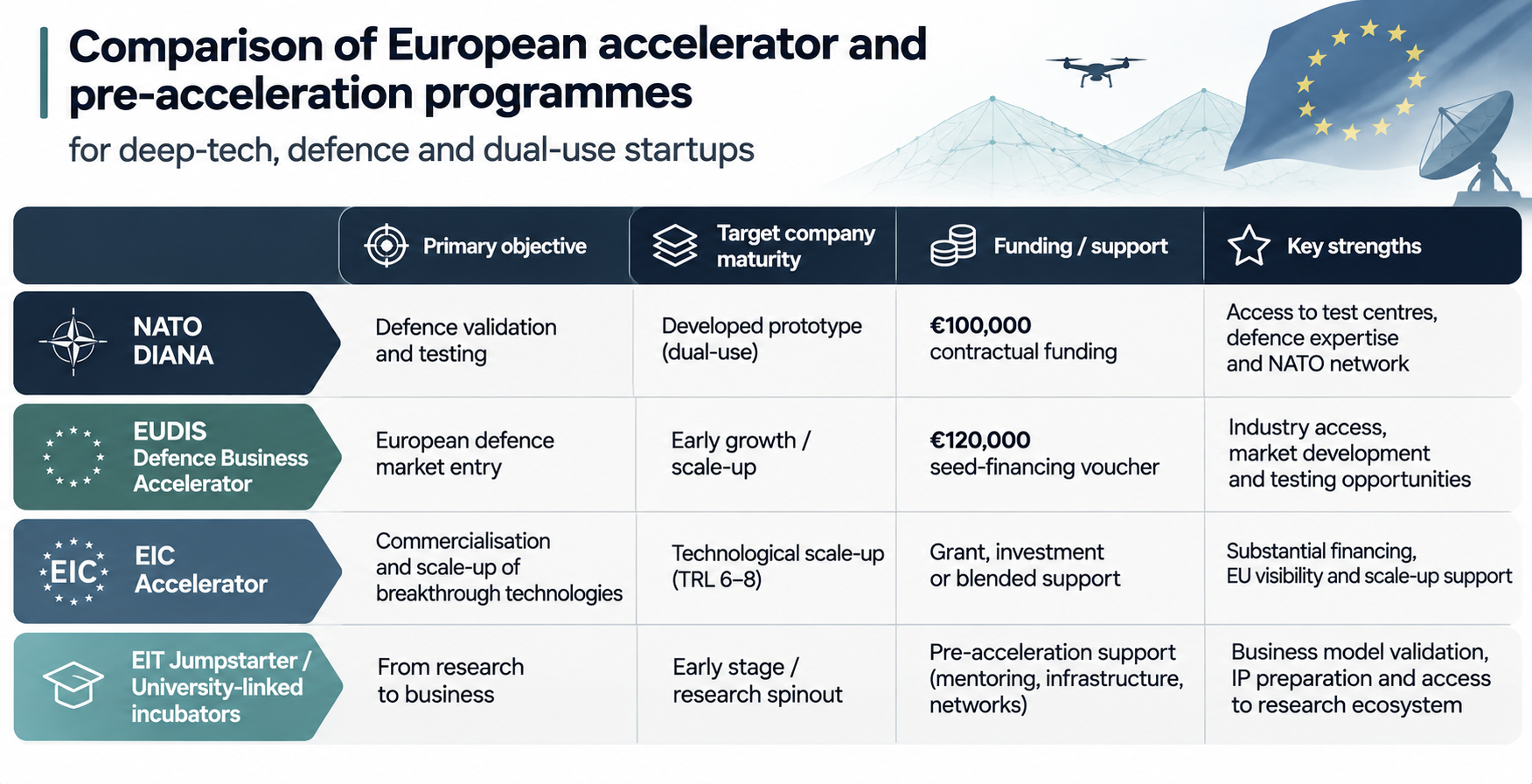
Figure 1. Comparison of European accelerator and pre-acceleration programmes for deep-tech, defence and dual-use startups, based on their primary objectives, target companies and principal forms of support.
Programme structures, eligibility criteria and financial conditions may change between application cycles. Founders should therefore consult the applicable official programme documentation before making an application or financial commitment.
NATO DIANA: Defence validation and access to allied innovation networks
The NATO Defence Innovation Accelerator for the North Atlantic (DIANA) supports innovative companies developing technologies that can address defence and security needs across the Alliance. DIANA operates through challenge-based calls, meaning that applicants respond to identified capability needs rather than submitting general startup development proposals. Selected innovators receive €100,000 in contractual funding and can benefit from access to technical and business expertise, defence-sector stakeholders and an extensive network of more than 200 test centres.
DIANA may be particularly relevant to dual-use companies that have established a credible technological proposition but need to understand defence-sector requirements, validate their technology in relevant environments or develop relationships with potential institutional users. Eligibility, however, should not be assessed solely by reference to the company's registered office. Applicable conditions also address matters such as incorporation, principal place of business, ownership and control within NATO member countries. Startups with complex international ownership structures or foreign strategic investors should review these requirements before committing significant resources to an application.
EUDIS Defence Business Accelerator: Entering the European defence market
The EUDIS Defence Business Accelerator, operating within the EU Defence Innovation Scheme, supports defence and dual-use startups and scale-ups seeking to strengthen their position within the European defence ecosystem. Its principal value lies in combining defence-specific business development with access to industry representatives, potential end users, investors and testing opportunities. The published programme framework includes an eight-month acceleration programme and a €120,000 seed-financing voucher for selected companies, subject to applicable programme conditions.
EUDIS can be particularly relevant to companies that have already developed a credible technology but need a better understanding of European defence procurement, commercial partnerships and market-entry requirements. Founders should distinguish the financial support available through the accelerator from the wider funding mechanisms operating under the European Defence Fund, as participation in one mechanism does not automatically establish eligibility for another.
The European Commission also states that it does not require equity or ownership of intellectual property rights solely in exchange for participation in the EUDIS Business Accelerator. Nevertheless, founders should review the detailed contractual provisions governing individual activities, testing arrangements and cooperation with programme partners.
EIC Accelerator: Commercialisation and scale-up of breakthrough technologies
The European Innovation Council (EIC) Accelerator supports startups and small and medium-sized enterprises developing innovations with significant market-creating or market-disrupting potential. Unlike a conventional mentoring accelerator, it is primarily a competitive innovation funding instrument that also provides access to business acceleration services. It is generally relevant to companies with technologies at Technology Readiness Levels 6 to 8 that require substantial resources to complete development, demonstrate commercial viability and prepare for market deployment. Depending on the applicable funding conditions, companies may receive grant support, investment support or a combination of both.
An important development occurred in June 2026, when the European Innovation Council expanded eligibility under the EIC Accelerator and STEP Scale Up framework to include qualifying dual-use innovations. This should not be interpreted as unrestricted eligibility for every defence technology under every Horizon Europe funding instrument, as the specific objectives, eligibility criteria and financing conditions of the relevant call remain decisive. Founders preparing applications for the following year should also consult the EIC funding opportunities for 2027.
For companies with a validated technological proposition, substantial capital requirements and a credible international growth strategy, the EIC Accelerator may offer a more suitable route than an earlier-stage incubation programme.
EIT Jumpstarter and university-linked incubators: From research to business
Not every promising technology is ready for an international defence accelerator or a major innovation funding application. Early-stage research teams and university spinouts may first need to establish a commercial proposition, assess market demand, clarify intellectual property ownership and identify an appropriate business structure. EIT Jumpstarter provides pre-acceleration support for eligible early-stage innovators, including participants from Slovenia and several Central and Eastern European countries.
University-linked incubators, technology parks and regional innovation hubs can also play an important role where the immediate objective is to commercialise research, establish an initial team or secure access to specialist infrastructure. Joining a prestigious international accelerator before the technology and business model are sufficiently mature may create unrealistic expectations and divert resources from more immediate development priorities. The decision should therefore be based on the company's actual needs rather than the perceived status of the programme.
How should founders choose the right accelerator for their technology readiness level?
Technology Readiness Levels, commonly referred to as TRLs, provide a structured method of describing technology maturity, ranging from basic scientific principles at TRL 1 to a proven system operating in its intended environment at TRL 9. TRLs are particularly useful when evaluating accelerator opportunities because different programmes support different stages of technological development. However, a TRL assessment does not establish commercial readiness, regulatory compliance or eligibility for a particular programme.
An early-stage research team may benefit most from business incubation, research partnerships and intellectual property preparation, while a company with an initial prototype may require access to relevant testing environments and technical expertise. A more mature startup may instead need significant capital, industrial partnerships and support entering international markets. Founders should therefore assess three separate dimensions: technology maturity, commercial maturity and regulatory readiness.
A startup with a technically validated product may still lack the contractual rights required to commercialise its underlying intellectual property, while another company with a strong civilian customer base may need further regulatory assessment before entering the defence market. The appropriate accelerator is the one capable of addressing the gap between the company's current position and its next measurable milestone.
What do evaluators look for in deep-tech and defence accelerator applications?
A competitive application should demonstrate more than technological ambition. Evaluators need to understand the problem being addressed, why the proposed solution is materially different from existing alternatives, what evidence supports its technical feasibility and whether the team can execute the proposed development plan. Although the applicable evaluation criteria vary between programmes, Horizon Europe research and innovation actions commonly assess excellence, impact and implementation quality, while the EIC Accelerator applies its own evaluation framework and investment-related considerations. Defence-focused programmes place additional emphasis on the relationship between technological capabilities and identified operational needs.
For founders, this means presenting a coherent case that connects the technology, the intended customer, the proposed validation activities and the commercial route. A strong application should also explain why the resources available through the particular programme are necessary. An application seeking access to testing facilities should identify what needs to be validated, while a company seeking scale-up support should explain the commercial and operational barriers preventing growth. Unresolved intellectual property ownership, inconsistent shareholder arrangements or uncertainty over regulatory restrictions may also affect the credibility of the proposed activities.
Legal expert insight | Dr. Peter Merc, founder of Lemur Legal and external evaluator for Horizon Europe and NATO DIANA
"A technically impressive solution is not automatically a strong defence proposition. What matters is whether the team can connect the technology to a specific operational need, explain how it will be tested in realistic conditions, and show a credible path from prototype to adoption. The strongest applications make that connection very clear."
This observation highlights the importance of presenting technology development as part of an executable commercial and operational strategy. A compelling application should demonstrate how participation in the programme advances a defined milestone rather than simply providing additional funding or visibility. Preparing an accelerator application can therefore be a useful opportunity to reassess the company's broader investment readiness, technology validation strategy and ability to enter new markets.
What legal issues should startups review before joining an accelerator?
Accelerator participation can involve access to valuable infrastructure, specialist knowledge, institutional networks and financial resources, but it can also create contractual obligations that affect the company's future commercial activities. These obligations deserve particular attention in deep-tech and defence environments, where intellectual property, technical information and ownership structures may have significant strategic value.
The following framework identifies five areas that founders should review before accepting programme funding, signing participation agreements or sharing sensitive technical information.
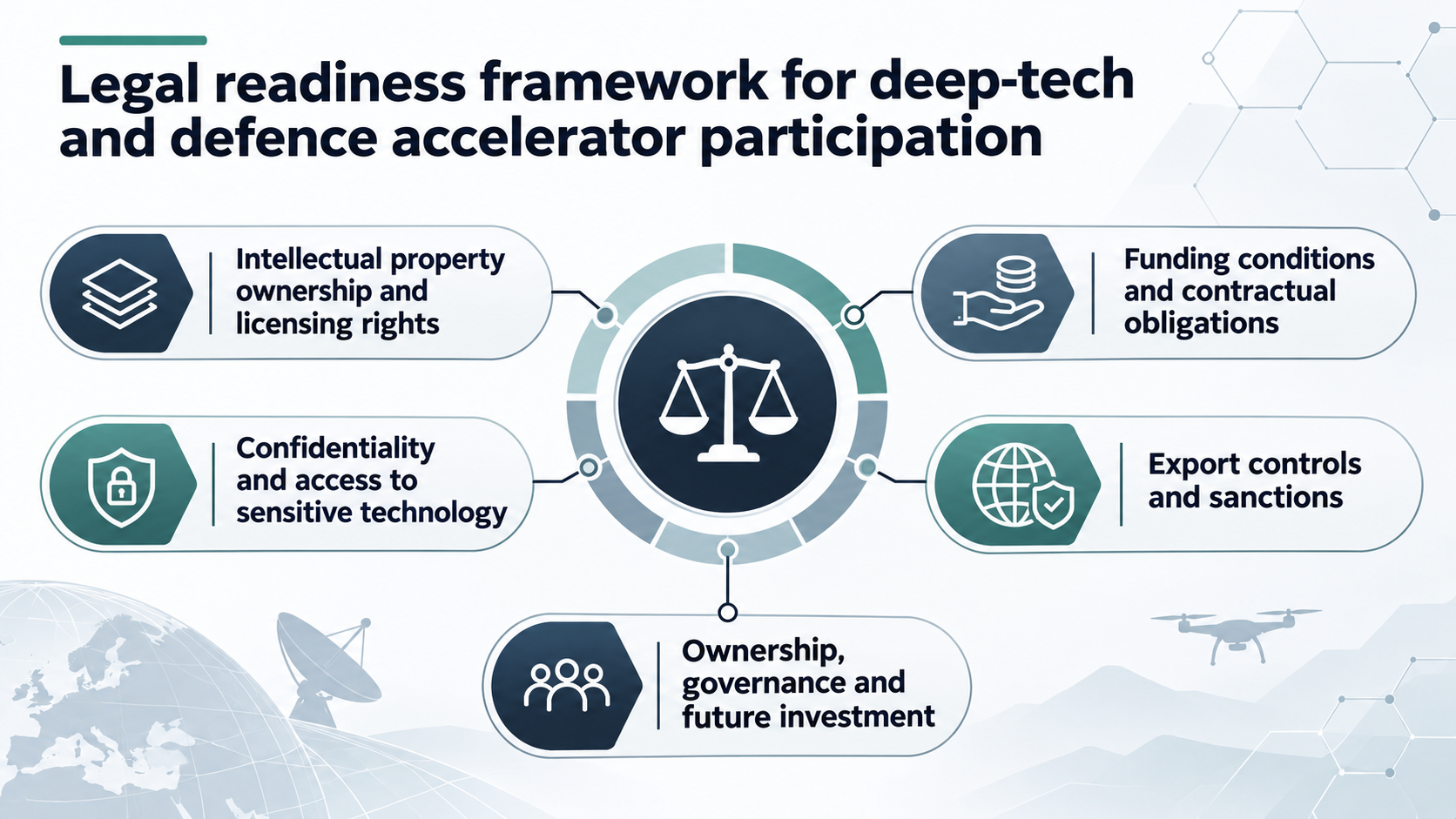
Figure 2. Legal readiness framework for deep-tech and defence accelerator participation, covering intellectual property, technology access, funding conditions, regulatory compliance and future investment implications.
Intellectual property ownership and licensing rights
A startup's ability to commercialise its technology depends on whether it owns or has sufficient rights to use the relevant intellectual property. For university spinouts and research-intensive businesses, this question can be particularly complex because technology may have been developed by founders while employed by a university, research institution or another company. It may also incorporate contributions from external developers, research partners or publicly funded projects.
Before joining an accelerator, founders should establish which intellectual property already belongs to the company, which rights are licensed from third parties and how intellectual property developed during the programme will be treated. Programme agreements should be reviewed for provisions addressing background intellectual property, newly created results, licences, access rights, publication and commercial exploitation. Even where a programme does not acquire ownership of the company's intellectual property, individual contractual provisions can affect how the technology may be used or disclosed. A documented IP protection strategy can help founders identify ownership gaps and establish the contractual foundations required for future commercialisation.
Confidentiality and access to sensitive technology
Accelerator participation frequently involves sharing technical information with mentors, programme operators, research partners, potential customers and investors. Founders should understand which information must be disclosed, who may access it and whether programme participants or external partners are subject to appropriate confidentiality obligations. This is especially important where the company's competitive advantage depends on proprietary software, technical know-how, trade secrets or unpublished research.
A disclosure obligation should not automatically be treated as permission to share every element of the technology. The scope of information sharing should be proportionate to the purpose of the relevant application, evaluation, testing or collaboration. Where intellectual property is subject to third-party contractual restrictions or applicable regulatory controls, the company must consider those restrictions independently of the accelerator's own confidentiality arrangements.
Funding conditions and contractual obligations
Financial support can be provided through grants, vouchers, investment agreements, contractual funding or other mechanisms, each carrying different legal and commercial consequences. Founders should review payment conditions, eligible expenditure, reporting obligations, milestone requirements, audit rights and the circumstances in which funding may be reduced, withheld or recovered. A programme may also impose commitments concerning attendance, testing activities, project duration, use of facilities or delivery of specified results.
Where financing involves equity or another investment instrument, additional considerations arise concerning dilution, governance, shareholder rights and future fundraising. The relevant commercial agreements and contractual arrangements should therefore be reviewed in the context of the company's broader business strategy rather than treating programme participation as an isolated transaction.
Export controls, sanctions and international collaboration
For defence and dual-use startups, participation in an international accelerator can create regulatory exposure even where no finished product is being sold or physically shipped. Certain cross-border transfers of software, technology or technical information may fall within the scope of Regulation (EU) 2021/821 and other applicable trade-control regimes. Whether an authorisation or other regulatory measure is required depends on the technology, the nature of the proposed activity and the relevant circumstances.
Access to international testing facilities, participation in cross-border research collaborations or disclosure of technical information to external parties may therefore require a preliminary regulatory assessment. A startup's selection for a defence accelerator does not itself establish that its technology is export-controlled, nor does participation provide an exemption from applicable export-control or sanctions requirements. Founders can find a more detailed explanation in our separate guide, What Is a Dual-Use Startup? Export Controls Explained for Founders.
Where the company's regulatory position remains uncertain, a Trade Regulatory Qualification can help establish which legal frameworks apply before the proposed activities begin.
Ownership, governance and future investment
Accelerators frequently create opportunities for founders to meet institutional investors, venture capital funds and strategic industrial partners. However, a subsequent investment can affect the company's ownership and governance structure, its eligibility for future programmes and its exposure to foreign investment-screening requirements. For strategically sensitive technologies, founders should consider whether an investment could trigger national screening procedures or other ownership-related restrictions, particularly where programme eligibility requirements address the nationality, location or control of participating companies.
These issues should ideally be assessed before entering substantive investment negotiations, especially where a company intends to participate in several international funding or defence innovation programmes. An Investment Readiness Review can help identify legal, ownership and regulatory issues before they become obstacles during investor due diligence.
Legal expert insight | Rok Bizjak, Defence & Dual-Use Legal Advisor at Lemur Legal
"Founders often focus on how much funding an accelerator offers without giving the same attention to its participation terms. For a deep-tech or defence company, a seemingly routine provision concerning technical information, access rights or collaboration with international partners can have consequences beyond the programme itself. The legal review should establish whether the company can meet those obligations without compromising its intellectual property, regulatory position or future investment opportunities."
Consider a university spinout participating in an international accelerator that offers access to specialist testing facilities. The company may assume that it can share all relevant technical information with the test facility because the activity forms part of the programme. However, the underlying technology may be subject to university licensing conditions, confidentiality obligations or regulatory restrictions that require separate assessment. The accelerator's participation agreement cannot automatically resolve these independent legal requirements.
This example illustrates why accelerator agreements should be assessed in the context of the company's existing rights and future commercial plans. Establishing the company's legal and regulatory position before testing or collaboration begins can help avoid conflicts between programme commitments and existing obligations.
Does participation in a defence accelerator guarantee access to defence contracts?
Accelerator participation can improve a company's understanding of defence markets, facilitate technology validation and provide access to relevant institutional networks, but it does not automatically result in a procurement contract. Defence customers operate within specific procurement, technical, security and contractual frameworks. A successful pilot or demonstration may provide valuable evidence of technological capability, although further evaluation and procurement procedures may still be required.
Founders should therefore distinguish between programme participation, technology validation, commercial engagement and actual procurement. This distinction is particularly important when preparing financial projections, as accelerator selection or successful completion should not be treated as equivalent to contracted revenue. Companies seeking to enter defence markets can consult our separate guide, Is Your Dual-Use Startup Ready for the NATO Market?, for a more detailed discussion of market-entry readiness.
Can startups participate in multiple accelerator and funding programmes?
Participation in one accelerator does not necessarily prevent a company from applying to another programme. However, founders should assess whether the relevant funding and participation conditions permit overlapping activities. Public funding mechanisms may impose restrictions on financing the same expenditure from multiple sources, while individual programmes may establish commitments concerning attendance, project milestones, exclusivity, reporting or the allocation of company resources.
Combining programmes can be commercially valuable where each addresses a different development need. An accelerator focused on market validation may, for example, complement research or commercialisation funding, provided that the applicable conditions are satisfied. The important distinction is between receiving complementary support for different activities and claiming funding more than once for the same eligible costs. Our separate guide to funding opportunities for dual-use innovation in Europe and the Balkans explores the wider financing ecosystem available to technology companies.
What should happen after a startup completes an accelerator?
Completing an accelerator should ideally leave the company with more than a certificate, an expanded network or an improved pitch deck. The relevant outcome may be validated technology, stronger commercial relationships, access to new customers, an investment-ready corporate structure or a clearer understanding of the applicable regulatory requirements. Founders should translate these outcomes into operational processes that support the next phase of growth.
For defence and dual-use businesses, this can involve maintaining appropriate records of technology classification, establishing procedures for international collaboration and creating a consistent approach to transaction screening, contractual approvals and information governance. These processes should remain proportionate to the company's size and regulatory exposure. As the business grows, formal Compliance Frameworks can help ensure that legal and regulatory responsibilities are integrated into everyday operations rather than addressed only when a new customer, investor or programme raises a question.
The long-term objective is to convert the opportunities created by accelerator participation into sustainable and legally compliant commercial growth.
Frequently asked questions about deep-tech and defence accelerators in Europe
What is a deep-tech accelerator?
A deep-tech accelerator is a structured programme supporting companies developing scientifically or technologically advanced innovations. It may provide access to technical expertise, testing infrastructure, commercial mentoring, investors and funding to accelerate technology development and market entry.
What is the difference between an incubator and an accelerator?
An incubator generally supports early-stage company formation, research commercialisation and business-model development. An accelerator typically provides more structured support aimed at achieving defined technological or commercial milestones within a limited period.
Which accelerator is best for defence and dual-use startups in Europe?
There is no universally best accelerator. NATO DIANA may be appropriate for companies addressing relevant defence challenges, EUDIS for European defence-market development, and the EIC Accelerator for eligible breakthrough innovations requiring substantial commercialisation and scale-up support.
How much funding does NATO DIANA provide?
Selected innovators under the published DIANA Accelerator Programme framework receive €100,000 in contractual funding. Additional support may be available through separate programme pathways, subject to applicable selection criteria and conditions.
Does the EUDIS Business Accelerator take equity?
The European Commission states that participation in the EUDIS Business Accelerator does not itself require companies to transfer equity or intellectual property ownership. Founders should nevertheless review the applicable participation agreement and any additional contractual arrangements.
Can dual-use startups apply for EIC Accelerator funding?
Yes. Following the June 2026 amendment to the EIC Work Programme, qualifying dual-use innovations became eligible under the relevant EIC Accelerator framework. Applicants must still satisfy the specific conditions of the applicable call.
Do defence accelerators own the intellectual property developed during their programmes?
Not necessarily. Intellectual property ownership, licensing and access rights depend on the applicable participation agreement and related contractual arrangements. Founders should review these provisions before joining a programme or commencing collaborative development.
Does joining a defence accelerator require an export licence?
Not automatically. However, certain technology transfers, exports or related activities undertaken during participation may require authorisation under applicable export-control legislation. The specific technology and activity must be assessed independently.
Can a startup participate in NATO DIANA and EUDIS?
Potentially, provided that the company satisfies the respective eligibility criteria and participation conditions. Founders must also review possible restrictions concerning overlapping funding, programme commitments and eligible expenditure.
Does participation in a defence accelerator guarantee a procurement contract?
No. Accelerator participation may facilitate access to potential customers, technical validation and commercial opportunities, but procurement remains subject to separate requirements and decision-making processes.
Choose the programme that advances your company, not just your funding position
Europe's expanding deep-tech and defence innovation ecosystem offers founders opportunities to access specialist infrastructure, institutional expertise, commercial partners and financial resources. However, the value of an accelerator should be measured against the company's next meaningful milestone rather than the amount of funding available or the reputation of the programme. Founders should establish whether the programme addresses their actual development needs, whether the company satisfies its eligibility conditions and whether the participation terms are compatible with its intellectual property, regulatory obligations and future investment strategy.
Lemur Legal advises deep-tech, defence and dual-use businesses on Trade Regulatory Qualification, Investment Readiness Reviews, IP Protection and Compliance Frameworks. The most effective time to address these matters is before entering into binding programme commitments, disclosing strategically valuable technology or accepting financing that may affect the company's future development.
For deep-tech and defence startups, acceleration creates the greatest value when technological progress, commercial opportunity and legal readiness develop together.
This article provides general legal and regulatory information and does not constitute individual legal advice. Programme eligibility, funding arrangements, intellectual property rights, export-control obligations and investment-screening requirements depend on the applicable programme documentation, contractual terms and current legislation.