

Choosing a fintech law firm can be a surprisingly difficult decision for an early-stage founder. At one end of the market are major international law firms with large teams, offices across multiple jurisdictions and established financial-services practices. At the other are smaller specialist firms concentrating on particular areas of technology, financial regulation or startup law. Both models can provide valuable legal advice, but they differ in the way they organise work, allocate resources, communicate with clients and structure fees.
For a crypto or fintech founder dealing with MiCA, a CASP authorisation, token classification, an exchange listing or a crypto legal opinion, the key question is not necessarily which firm has the largest international presence. It is whether the legal team understands the specific regulatory challenge, can work effectively with the company's business and technology teams, and can produce advice or documentation that will withstand scrutiny from regulators, exchanges, investors and other relevant parties. A smaller firm is not automatically more cost-effective, just as a larger firm is not automatically better equipped for every regulatory issue.
The choice between a boutique fintech law firm and Big Law should be driven by the legal matter, not the size or reputation of the firm alone. This guide explains the differences between the two models, when each may be appropriate, how fixed-fee arrangements compare with hourly billing and which questions founders should ask before engaging a crypto or fintech lawyer.
What does a fintech law firm actually do?
A fintech law firm advises businesses operating at the intersection of financial services, technology, regulation and commercial law. For companies dealing with crypto-assets in Europe, this increasingly requires an understanding of the Markets in Crypto-Assets Regulation (MiCA) alongside financial-services legislation, anti-money laundering requirements, operational resilience rules and other obligations that may apply to the same product. Fintech legal advice is therefore not limited to deciding whether a token is regulated or preparing the documents needed for a particular licence. It often requires a broader assessment of how a business is structured, which activities it performs and who is legally responsible for them.
Depending on the project, legal work can include token classification, crypto legal opinions, MiCA white papers, CASP authorisation, AML/CFT compliance, governance arrangements, outsourcing agreements, agreements with service providers, payment-related questions and ongoing regulatory support. A startup may also need advice about intellectual property, fundraising, shareholder rights or employee equity, particularly where those issues affect its regulated activities or investor readiness. The legal needs of a token issuer, a custodial service provider and a payments platform may therefore differ significantly even though all three businesses describe themselves as fintech companies.
A CASP authorisation application illustrates the breadth of this work. Article 62 of MiCA requires information concerning the applicant's legal structure, programme of operations, governance, prudential safeguards, internal controls and other arrangements relevant to its proposed services. The task involves more than completing an application form. It requires converting the company's actual management structure, technical operations and compliance arrangements into a coherent regulatory submission that can be assessed by the competent authority.
A good fintech lawyer must therefore understand both the applicable legal requirements and the product to which they are being applied. Advice can be legally accurate yet commercially unhelpful if it ignores how a technology platform works, what the founders are trying to launch or which decisions must be made before the next development milestone.
Boutique vs Big Law: what is the actual difference?
The term Big Law is generally used to describe large national or international commercial law firms with extensive specialist departments, substantial organisational infrastructure and the ability to staff complex matters with lawyers from multiple practice areas. Such firms can be particularly effective when a transaction requires simultaneous input from regulatory, corporate, tax, employment, competition, litigation and other teams. Their international networks may also help coordinate advice across jurisdictions, subject to the structure of the firm and its local capabilities.
A boutique fintech law firm generally operates with a smaller team and a more focused practice. Rather than maintaining numerous legal departments, it may concentrate on crypto regulation, fintech licensing, payments, technology transactions or startup-related legal matters. This narrower focus can allow direct involvement by senior lawyers who routinely work on particular regulatory issues. In some engagements, the same lawyer may lead the initial discussion, examine the business model, develop the legal analysis and manage communication with the client.
These differences create potential advantages rather than guaranteed outcomes. A boutique may offer greater continuity and a more focused team, but it can have limited capacity for a transaction requiring substantial simultaneous work across several jurisdictions. A large firm may offer broader resources, but the client should still establish which lawyers will actually perform the work and whether the team has relevant experience with the specific product or regulatory issue.
A third possibility is a hybrid legal team, in which specialist counsel leads the relevant regulatory work while additional lawyers support particular jurisdictions, transactions or legal disciplines. This model can combine focused expertise with broader capabilities, provided that responsibilities and coordination arrangements are clearly defined.
The relevant question is not whether boutique firms are generally better than large firms. It is which operating model matches the complexity, scope and risk profile of the particular legal matter.
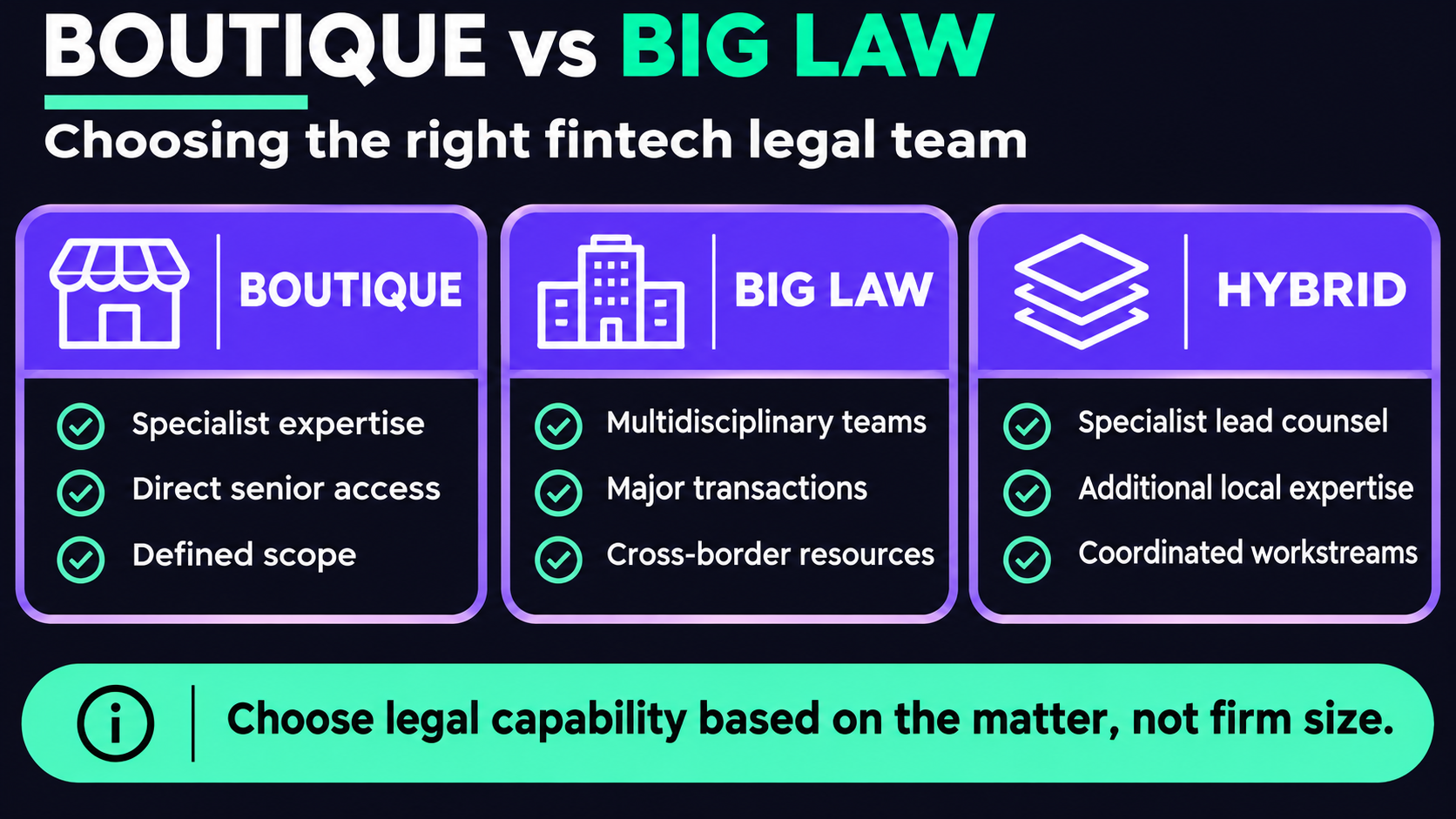
Figure 1. Overview of three legal support models: boutique fintech law firms, large international practices and hybrid teams. Each offers different potential strengths in specialist expertise, multidisciplinary work and cross-border coordination.
When does a boutique fintech law firm make sense?
A boutique fintech practice may be particularly well suited to a specialised regulatory issue involving a relatively lean organisation. An early-stage crypto company does not necessarily need a large legal team when its immediate priority is determining whether a token falls within MiCA, preparing a legal opinion for an exchange or identifying the regulatory steps required before launching a product. It may benefit more from working directly with a lawyer who regularly addresses the precise category of question and understands how the outcome affects the business model.
Typical matters that can suit a specialist boutique include crypto legal opinions, token classification, MiCA white papers, preliminary regulatory assessments, defined compliance documentation and aspects of CASP authorisation support. The specific firm's experience remains essential: a practice focused on token issuance may not automatically possess equivalent expertise in payment services, electronic money or complex regulatory investigations. Founders should therefore evaluate the team's work in the relevant subdiscipline rather than rely on a broad description of crypto expertise.
One potential advantage of a specialist practice is continuity. The lawyer discussing the proposed product with the founder may also examine its tokenomics, prepare the classification analysis and explain the results to the wider team. This can reduce the risk that important technical or commercial information is lost between successive layers of a large engagement team. For a startup making frequent product decisions, the ability to discuss regulatory consequences directly with the person responsible for the work may be particularly valuable.
The benefit should not be reduced to a claim that boutique firms are always cheaper or faster. What matters is the combination of relevant expertise, realistic availability, clear responsibility and an engagement structure proportionate to the legal problem.
When is Big Law the better choice?
There are legal matters where the scale and breadth of a major international firm can be a substantial advantage. A fintech company undertaking a significant cross-border acquisition may simultaneously need specialists in financial regulation, corporate transactions, tax, competition, employment, intellectual property and data protection. Major litigation, regulatory investigations involving several jurisdictions and complex institutional financing can also require extensive resources that a small specialist firm may not be able to provide without involving external advisers.
Large international firms may be especially suitable where substantial work must be carried out in parallel, multiple legal disciplines interact or several local legal systems need to be addressed within a coordinated transaction. The capability to assemble different specialist teams under a common engagement can be valuable, particularly where the matter involves a large financial institution, numerous contractual counterparties or significant transactional risk.
Nevertheless, the size of the client does not automatically determine the appropriate type of law firm. An early-stage startup involved in a complex international acquisition may need a major transactional team, while an established financial-services business seeking a narrowly defined crypto classification assessment may find a specialist boutique better suited to the task. The complexity of the matter, not the company's funding stage or valuation, should determine the necessary legal resources.
Founders should therefore avoid committing every legal issue to one provider solely because that provider is already advising on a separate transaction. Different matters may justify different combinations of expertise, team size and billing arrangements.
Comparison: boutique fintech law firm, Big Law or a hybrid team?
Comparing law firms solely by their size provides limited information about whether they are suitable for a particular regulatory matter. A founder should instead assess the expertise required, access to experienced lawyers, available resources, complexity of the transaction and expected level of ongoing support. Each legal service model has potential strengths, but those strengths must be evaluated against the actual work the company needs.
The following comparison examines seven decision factors relevant to crypto and fintech founders. It distinguishes the focused regulatory work often associated with specialist boutiques from the broader multidisciplinary resources that large international firms may provide. It also considers the hybrid approach, in which a lead adviser coordinates additional expertise when needed.
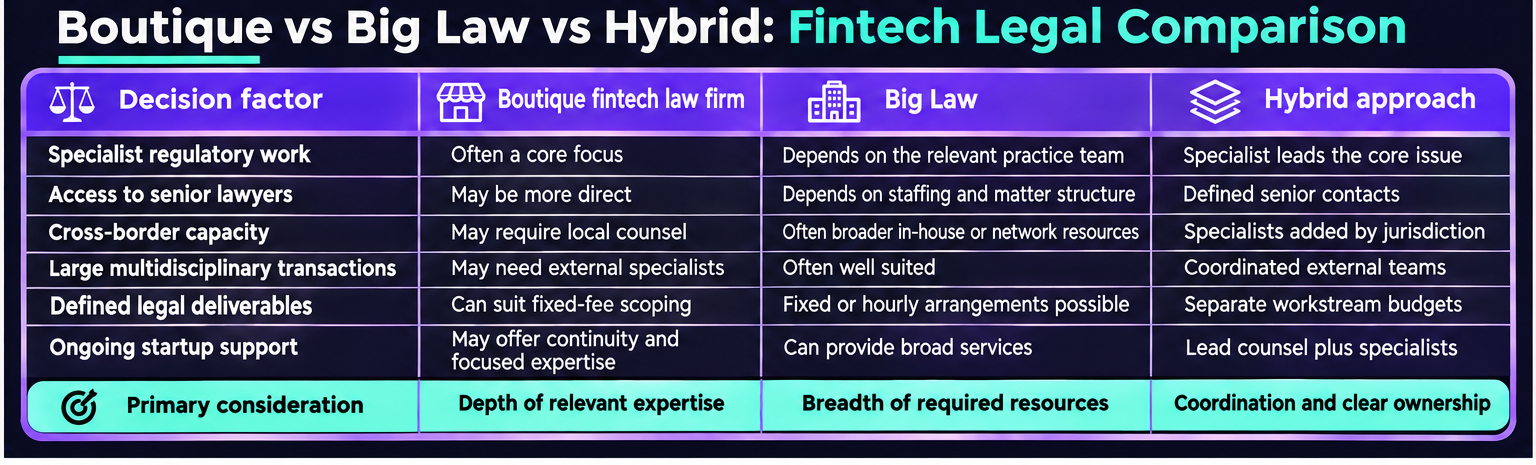
Figure 2. Comparison matrix evaluating boutique fintech law firms, Big Law and hybrid legal teams across specialist expertise, senior-lawyer access, cross-border capabilities, multidisciplinary transactions, fee arrangements, ongoing support and overall suitability.
The purpose of this comparison is not to establish a universal ranking. A firm with substantial international resources may still lack the specific expertise required for a narrowly defined token-classification issue, while a specialist boutique may need external support for a major international transaction. Founders should therefore use the matrix to identify which capabilities are essential for their matter and then assess whether the proposed team can actually provide them.
A hybrid arrangement can be particularly relevant where a startup's core regulatory work is relatively specialised but individual projects introduce additional legal requirements. However, combining multiple advisers is only effective when responsibilities are clearly allocated. Otherwise, the company may face duplicated work, inconsistent legal assumptions and unnecessary coordination costs.
Do you need Big Law for a MiCA licence?
No. MiCA does not require an applicant for CASP authorisation to engage a law firm of any particular size. The regulatory assessment focuses on whether the applicant itself meets the applicable requirements and whether its submission provides the competent authority with the information needed to evaluate those requirements. A qualified specialist adviser can assist with the process, but the regulator ultimately determines whether authorisation is granted.
Article 62 of MiCA establishes the relevant application-information requirements, while Article 63 governs the assessment and decision process. Among other matters, an applicant must address its business activities, governance, prudential arrangements, risk controls and service-specific obligations. Its advisers therefore need to understand how the company actually operates, including who controls client assets, how orders are executed, how outsourcing is supervised, which entities perform particular functions and how responsibilities are allocated.
The time needed to obtain authorisation should also be understood correctly. MiCA provides an initial completeness-assessment period of 25 working days and a substantive assessment period of 40 working days for a complete application, subject to the relevant procedural rules and additional-information requests. These periods should not be presented as a guaranteed total licensing timeline. Preparing the application, establishing adequate operational arrangements and responding to regulatory questions can require substantially more time.
For an early-stage applicant, a specialist legal team with relevant CASP experience may therefore be appropriate. A larger firm can become useful when the application forms part of a more complex restructuring, international acquisition, institutional financing or regulatory project involving several separate legal disciplines.
For the detailed EU authorisation process, see our MiCA licence guide. This article addresses how to select the legal team rather than repeating the procedure itself.
Fixed-fee crypto lawyers vs hourly billing
Pricing is another important consideration when comparing fintech legal advisers. Traditional commercial legal services are frequently billed on an hourly basis, with fees calculated according to the time spent by the professionals involved. This approach can be appropriate when the scope of work is genuinely unpredictable, especially in disputes, negotiations, investigations or complex transactions where external parties influence the required workload.
For clearly defined regulatory deliverables, founders may prefer a fixed-fee engagement because it provides greater visibility over the expected cost. Work such as a defined crypto legal opinion, token-classification assessment, MiCA white paper or regulatory gap analysis may be suitable for advance scoping. However, the possibility of agreeing a fixed fee depends on how clearly the parties can establish the relevant facts, deliverables, assumptions and boundaries of the assignment.
A fixed fee is not automatically cheaper than hourly billing. Nor does it necessarily include unlimited revisions, additional jurisdictions, substantial changes in the token structure or extended regulatory correspondence. The commercially important issue is whether the engagement explains what is included, which circumstances may require additional work and how changes will be approved and priced.
Hourly billing can offer flexibility, but founders should ask for estimates, relevant hourly rates, reporting intervals and budget controls. A hybrid fee arrangement may also be appropriate where some deliverables can be defined precisely but other stages depend on external negotiations or regulatory feedback.
Lemur Legal provides specialist services through defined scopes of work and agreed fee arrangements. This approach is relevant to founders who want to understand the deliverable and financial commitment before the engagement begins. The precise fee and scope should nevertheless be established for each matter rather than inferred from a general description of the service.
How should founders compare legal fees?
Comparing two proposals solely by their quoted total price can produce misleading results if the work included is different. One proposal may cover only an initial memorandum, while another includes interviews with the technical team, revisions, supporting documentation and a defined round of regulatory questions. Similarly, one provider may assume that the business model and tokenomics are final, while another has included a preliminary legal assessment because those matters are still being developed.
Founders should therefore compare the scope of work, named personnel, responsibilities, assumptions, exclusions, revision policy, communication arrangements and treatment of external costs. Where a regulator or exchange may request further information, the engagement should explain whether responding to those requests is included and, if not, how the additional work will be handled. The same applies when several jurisdictions or affiliated companies are involved.
A useful legal proposal should allow the founder to understand what decision or deliverable will exist at the end of the engagement. It should also clarify which matters remain outside scope so that the company does not mistakenly assume a token opinion covers CASP licensing, or that a MiCA white paper addresses every obligation affecting the proposed business.
Price is therefore only meaningful when assessed against the actual legal work and the risk that the work is intended to address.
What should founders ask before hiring a crypto lawyer?
Founders should evaluate a fintech law firm by asking who will actually perform the work and what experience that person has with the specific regulatory problem. A partner who leads the introductory call may not necessarily draft the documentation or manage the matter after the engagement begins. This distinction is particularly relevant where the value of the service depends on specialist judgement and familiarity with the technology.
The founder should also establish whether the team has worked on the same category of issue. Experience with crypto-assets is too broad a description on its own: token classification, exchange listing, MiCA white papers, CASP authorisation, EMI licensing and AML programmes are distinct legal assignments. A strong adviser should be able to explain the relevant legal framework, identify its assumptions and describe the information needed from the company's technical and management teams.
Before engaging a law firm, founders should clarify six questions:
Who will actually perform the work? Identify the lawyer responsible for the analysis, client communication and any regulator-facing activities.
What relevant experience does the team have? Ask about similar legal matters without expecting disclosure of confidential client information.
What is included in the proposal? Confirm deliverables, jurisdictions, assumptions, revisions and potential additional work.
How does the firm address legal uncertainty? Credible advice should explain uncertainty rather than provide unsupported guarantees.
Does the lawyer understand the technology? The analysis may depend on custody arrangements, smart-contract functionality, tokenholder rights and the responsibilities of different entities.
What happens after delivery? Determine whether subsequent questions from exchanges, investors, banks or regulators are included in the engagement.
Founders should be cautious about promises of guaranteed regulatory authorisation, guaranteed token classification or guaranteed exchange listing. A law firm can prepare legal analysis and support a regulatory process, but it cannot guarantee decisions taken by competent authorities or independent commercial counterparties.
Specialist legal advice is not the same as a document template
A specialist boutique law firm should not be confused with a low-cost document provider offering generic opinions or compliance packages. The distinction is not necessarily the size of the firm or the price charged. It is whether the work involves reasoned legal analysis of the client's actual circumstances, including the difficult questions that may affect the legal outcome.
For a crypto legal opinion, those questions may concern tokenholder rights, financial characteristics, distribution and the interaction between the token and the underlying business. For a MiCA white paper, the analysis may require checking whether the disclosures accurately reflect the token's design and the applicable regulatory framework. For a CASP application, the legal team must understand the provider's actual operational arrangements rather than assume that standardised policies are sufficient.
A template can appear comprehensive while failing to address a material feature of the project. It can also be inconsistent with the company's website, tokenomics, terms or technical infrastructure. Such inconsistencies may become apparent during exchange due diligence, investor review or regulatory assessment, potentially creating more work than was saved at the outset.
The meaningful comparison is therefore not simply between an expensive international firm and an inexpensive small provider. It is between legal work that provides a defensible assessment of the relevant issues and documentation that only appears to satisfy a checklist.
When should a startup use a hybrid legal team?
Not every fintech company needs to make a permanent choice between one boutique firm and one large international practice. A hybrid arrangement can allow a startup to use specialist counsel for its day-to-day regulatory work while involving additional professionals for particular jurisdictions, transactions or legal disciplines. This model can be useful when the company's core activities are relatively focused but individual projects introduce specialist requirements.
For example, a crypto company may use a boutique practice for token classification, MiCA documentation and ongoing regulatory questions, while engaging local counsel in another Member State for a defined corporate or regulatory issue. If the company later undertakes a major acquisition or complex financing, it may appoint a larger transaction team while retaining specialist crypto counsel for the regulatory elements of the deal.
Such an arrangement is only effective when responsibilities are clearly allocated. The company should know which adviser coordinates the matter, who reviews overlapping legal questions and how the different workstreams will remain consistent. Otherwise, a hybrid approach can create duplicated advice, conflicting assumptions and unclear accountability.
The objective is not to minimise the number of lawyers involved at all costs, but to match the team to the legal problem while maintaining efficient coordination.
Frequently asked questions about fintech law firms
What does a fintech law firm do?
A fintech law firm advises businesses on financial regulation, technology, commercial arrangements and related legal obligations. For crypto businesses, relevant work may include MiCA, CASP authorisation, token classification, legal opinions, white papers, AML/CFT and ongoing regulatory compliance.
What is a boutique fintech law firm?
A boutique fintech law firm is a smaller legal practice focused on a defined group of specialist issues, such as crypto regulation, fintech licensing, payments or technology law. Its main distinguishing feature is the concentration of expertise rather than its size alone.
Is a boutique law firm better than Big Law for a crypto startup?
Not necessarily. A specialist boutique may be suitable for a focused regulatory problem, while a large international firm may be more appropriate for a complex transaction involving multiple jurisdictions and legal disciplines. The individual team's relevant experience is more important than the firm's category.
Do I need a large law firm for a MiCA licence?
No. MiCA does not impose requirements concerning the size of the applicant's external law firm. The applicant must satisfy the regulatory requirements, and the advisers should have the expertise and resources necessary to support the process effectively.
How do fixed-fee crypto lawyers compare with hourly billing?
Fixed fees can provide greater cost predictability for well-defined deliverables, while hourly billing can offer flexibility where the workload is uncertain. Founders should compare the scope, exclusions, revisions and treatment of additional work rather than assume that one billing model is always cheaper.
Can a boutique fintech lawyer help with CASP authorisation?
Yes, provided the lawyer or team has the relevant regulatory expertise and capacity. The suitability of a particular firm depends on the applicant's business model, the scope of services and any additional legal disciplines required.
Can a crypto lawyer guarantee a licence or exchange listing?
No credible adviser should guarantee an outcome controlled by a regulator or independent exchange. A lawyer can assist with legal analysis, documentation and regulatory engagement, but the final decision remains with the relevant authority or commercial counterparty.
When should a startup engage Big Law?
A larger international firm may be appropriate for substantial cross-border transactions, complex institutional financing, major disputes, investigations or matters requiring extensive multidisciplinary resources. A startup can face such issues even at an early stage.
Can I use a boutique law firm and Big Law together?
Yes. A startup may retain specialist counsel for ongoing regulatory matters and engage additional lawyers for particular jurisdictions or transactions. The arrangement should clearly allocate responsibilities to avoid duplicated work or inconsistent advice.
How do I choose the right crypto or fintech lawyer?
Start by defining the legal question and identifying the necessary expertise. Then compare the lawyers who will perform the work, their experience with similar issues, their understanding of the technology, the proposed scope and the fee arrangements.
Choosing the right fintech law firm
For most early-stage founders, the decision between a boutique fintech law firm and Big Law becomes easier once the legal issue has been properly defined. Where a company needs a multinational team for a significant acquisition, complex financing, major litigation or a broad regulatory investigation, a large international practice may provide capabilities that a smaller specialist firm cannot efficiently replicate. Where the immediate matter concerns token classification, a MiCA white paper, a crypto legal opinion, CASP authorisation or defined compliance support, a boutique with relevant expertise may offer a more focused engagement.
Neither model is automatically the better choice. The quality of the legal advice depends on whether the team understands the actual business model, the applicable regulation and the company's commercial objective. A useful legal adviser should be able to connect those elements and produce work that remains coherent when examined by a regulator, exchange, investor or bank.
Lemur Legal's Crypto & Fintech practice focuses on specialist regulatory matters for technology-driven businesses. The firm advises on Crypto Legal Opinions, MiCA White Papers and Regulatory Compliance, with work structured around defined deliverables and agreed fees.
The most useful starting point when choosing a fintech law firm is not the firm's headcount. It is a clearly defined legal problem and a team equipped to solve it.
This article provides general information and does not constitute individual legal advice. The suitability of any legal adviser depends on the nature, jurisdiction and complexity of the matter. The scope and fees of legal services should be confirmed in the relevant engagement agreement.