

Preparing a crypto-asset white paper under the EU Markets in Crypto-Assets Regulation (MiCA) is a regulatory exercise, not simply a writing project. A document explaining a token's commercial potential may be useful to investors, but it does not automatically satisfy the disclosure, notification and formatting requirements imposed by MiCA.
For founders preparing a token launch or admission to trading in the European Union, the challenge is connecting legal classification, tokenomics, corporate information, technical documentation and the applicable regulatory procedure. An inconsistency between these elements can be more consequential than an omitted heading. The white paper must accurately reflect the project's legal and economic structure while meeting the requirements applicable to its particular category of crypto-asset.
This guide explains the practical MiCA whitepaper requirements, including mandatory disclosures, differences between token categories, regulatory notification, iXBRL formatting and the documentation founders should prepare before submission.
For a general introduction to the concept and its purpose, see Understanding the MiCA crypto-asset white paper.
What determines the applicable MiCA whitepaper requirements?
Before drafting begins, a project must identify which regulatory category applies to its crypto-asset. This determines the relevant disclosure framework, the applicable regulatory procedure and the person or entity responsible for preparing the document. MiCA distinguishes between crypto-assets other than asset-referenced tokens (ARTs) and e-money tokens (EMTs), ARTs and EMTs. Crypto-assets qualifying as financial instruments under MiFID II fall outside MiCA's scope, while other exclusions may also apply.
For crypto-assets governed by Title II, the principal disclosure requirements are established in Article 6 and Annex I. ART white papers are regulated under Article 19 and Annex II, while EMT white papers are governed by Article 51 and Annex III. These regimes share certain principles, particularly concerning transparency and the accuracy of information, but their requirements are not interchangeable. An issuer using a generic Title II template for an ART, for example, could overlook disclosures and legal obligations specific to asset-referenced tokens.
It is also essential to identify the party responsible for the white paper. Depending on the circumstances, this may be the offeror, the person seeking admission to trading, the issuer or a trading-platform operator acting under the relevant provisions. The responsible entity must be accurately reflected in the document and supporting materials. A defensible drafting process therefore begins with legal classification, identification of the responsible party and confirmation of the applicable regulatory framework.
What information must a MiCA crypto-asset white paper contain?
For crypto-assets other than ARTs and EMTs, Article 6 of MiCA and Annex I establish the core disclosure requirements. The information must be fair, clear and not misleading, without material omissions, allowing prospective holders to understand the crypto-asset, the project, the rights involved and the associated risks.
The document must identify the relevant responsible person and provide the prescribed corporate, management and contact information. Where applicable, information about the issuer or operator of a trading platform must also be included. Project disclosures should explain the business activity, relevant participants, development plans and intended use of funds. These details must be consistent with corporate records, contractual arrangements and other project documentation. A white paper should not identify one company as responsible while associated agreements point to another without a clear explanation of the legal relationship.
The white paper must also describe the characteristics of the crypto-asset and the conditions of its public offering or admission to trading. Relevant information may include token supply, issuance and distribution arrangements, pricing, restrictions, governance mechanisms and the rights granted to holders. These disclosures must accurately reflect the tokenomics and technical functionality. If marketing materials describe a fixed token supply but the smart contract permits additional minting, the discrepancy must be examined and appropriately addressed before publication.
Another essential element is the explanation of the underlying technology and associated risks. The document must describe relevant distributed ledger technology, technical protocols, token functionality and material risks relating to the project, market conditions, security, liquidity and the rights of holders. Generic cryptocurrency risk warnings are not sufficient if they fail to reflect the project's actual characteristics. The applicable framework also requires information about the principal adverse impacts of the consensus mechanism on the climate and other environment-related matters, in accordance with the relevant technical standards.
Finally, MiCA prescribes formal statements, warnings and presentation requirements. For Title II white papers, these include a management-body statement, prescribed investor warnings, a summary, a table of contents and the notification date. The document must also satisfy the applicable language and machine-readable formatting requirements. These elements should be incorporated into the drafting process from the beginning rather than added immediately before submission.
How do disclosure requirements differ between token categories?
Although MiCA establishes common principles of transparency and regulatory accountability, the white paper requirements vary considerably depending on the legal classification of the crypto-asset.
For crypto-assets other than ARTs and EMTs, the relevant disclosure framework is generally found in Title II, particularly Article 6 and Annex I. These provisions address the responsible person, project, public offering or admission to trading, token characteristics, holder rights, technology and associated risks.
ARTs are subject to a separate framework under Article 19 and Annex II, with additional disclosures concerning the reserve of assets, stabilisation mechanisms and rights associated with the token. EMTs are governed by Article 51 and Annex III, which address requirements relevant to e-money tokens, including information about the issuer, holder rights and redemption arrangements.
The distinction affects more than the structure of the document. It can determine which entities are permitted to issue the asset, whether authorization is required and which regulatory procedure applies. The correct classification must therefore be established before selecting the disclosure structure or preparing the final documentation.
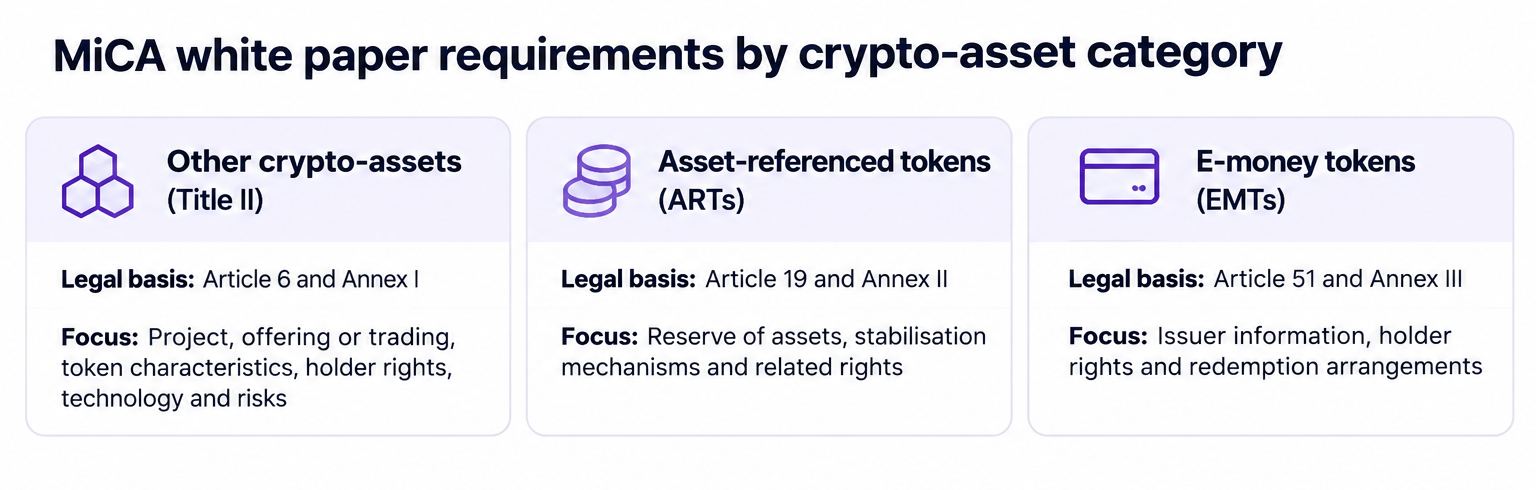
Figure 1. Comparison of the applicable MiCA white paper disclosure frameworks for other crypto-assets, asset-referenced tokens (ARTs) and e-money tokens (EMTs).
Legal expert insight
“A MiCA white paper should never begin with a template. The starting point is the token itself: its economic characteristics, holder rights, underlying technology and intended distribution. These determine the regulatory category and, consequently, the correct disclosure requirements. A polished document built on an incorrect classification remains the wrong document.” Dr. Peter Merc, founder of Lemur Legal
How does the MiCA white paper notification process work?
For crypto-assets governed by Title II, the regulatory procedure generally involves notification rather than prior approval of the white paper. Under Article 8 of MiCA, the prescribed notification must be submitted to the competent authority of the home Member State at least 20 working days before publication. The notification must also include an explanation of why the crypto-asset is not excluded from MiCA's scope, is not an ART and is not an EMT.
The distinction between notification and authorization is important. Under the Title II framework, the competent authority does not approve the white paper before publication. The responsible person must nevertheless ensure that the document satisfies the applicable legal requirements and that the notification and publication procedures are followed correctly. Different procedures apply to ARTs and EMTs, which must be considered separately.
Under Article 9 of MiCA, the white paper must be published in accordance with the relevant requirements before the applicable public offering or admission to trading. The published document must correspond to the version notified to the authority, subject to the rules concerning subsequent modifications.
Founders should therefore avoid assuming that a completed document is automatically ready for publication. The identity of the responsible entity, the applicable notification deadline, the accompanying classification explanation and the final published version must all be verified. Projects preparing a public offering or admission to trading may benefit from professional MiCA white paper drafting and regulatory support, particularly where multiple legal and technical requirements must be coordinated.
What are the iXBRL formatting requirements?
Preparing a MiCA white paper is not solely a legal drafting exercise. The regulatory framework also requires information to be presented in a prescribed machine-readable format. The applicable implementing technical standards provide for Inline XBRL (iXBRL), which combines human-readable presentation with structured information that can be processed electronically.
The relevant formatting standards have applied since 23 December 2025. This means that projects preparing white papers must consider not only the wording of disclosures but also the technical requirements governing their structure and submission. The ESMA MiCA white paper taxonomy and reporting resources provide guidance and supporting materials for preparing compliant documents.
This requirement creates a direct connection between legal drafting and technical data management. Information that appears consistent in a narrative document may become problematic when it must be assigned to structured fields. Inconsistent corporate information, token classification, numerical values or project details can create difficulties during validation and submission.
A reliable drafting process should therefore incorporate the applicable technical structure from the outset. Legal advisers, project teams and technical specialists should work from a consistent set of verified information, rather than treating iXBRL conversion as a final administrative task. Before submission, the current technical specifications and relevant national filing arrangements should also be checked.
What should issuers prepare before drafting a MiCA white paper?
The quality of a MiCA white paper depends on the accuracy, completeness and consistency of the underlying information. Before drafting begins, the responsible team should collect the legal, financial, technical and commercial documentation needed to describe the project and its crypto-asset accurately.
Depending on the relevant token category and proposed activity, the preparation process should cover:
Corporate information and identification of the responsible legal entity.
Tokenomics, supply, allocation and distribution arrangements.
Token holder rights, contracts and applicable terms.
Technical documentation and relevant smart-contract functionality.
Business model, project development plans and offering arrangements.
Marketing materials and existing public representations.
Relevant financial information and project-specific risk assessments.
Environmental and sustainability information concerning the consensus mechanism.
Any existing token classification analysis or legal opinion.
The documents should be checked for consistency before the first complete draft is prepared. For example, the distribution arrangements described in the white paper must correspond to the tokenomics and contractual documentation. Similarly, rights described in promotional materials must not contradict the rights actually granted under the applicable agreements.
One of the most common problems is treating a white paper as a standalone document rather than part of the project's wider legal and operational framework. A tokenomics presentation may describe one distribution model while investor agreements describe another. Marketing materials may promise functionality that the technology does not yet provide, or an issuer may fail to update important disclosures after changing its business model.
Generic risk statements can create similar problems when they do not reflect the actual characteristics of the crypto-asset. A sound preparation process should therefore include cross-document verification, review of the applicable MiCA annex, confirmation of mandatory statements and warnings, and validation of the required technical format.
Where token classification is uncertain or a third party requires formal legal analysis, a separate crypto legal opinion may also be appropriate. The purpose is not simply to produce a document resembling a regulatory template, but to ensure that the disclosures accurately describe the project and are supported by defensible legal reasoning.
Frequently asked questions about MiCA whitepaper requirements
What must a MiCA white paper include?
The required information depends on the crypto-asset category. For Title II assets, Article 6 and Annex I prescribe disclosures covering responsible entities, the project, offering terms, token characteristics, holder rights, technology, risks and environmental impacts, together with mandatory statements and formal elements.
Is there one MiCA white paper template for every token?
No. MiCA establishes different disclosure frameworks for crypto-assets other than ARTs and EMTs, ARTs and EMTs. The correct structure depends on the asset's legal classification and the applicable regulatory procedure.
Does a MiCA white paper require regulatory approval?
For Title II crypto-assets, the white paper is generally notified rather than approved before publication. Other token categories, particularly ARTs, may involve different authorization and approval arrangements.
When must a Title II white paper be notified?
Where Article 8 applies, the prescribed notification must generally be made at least 20 working days before publication, together with the relevant accompanying information.
Is iXBRL required for MiCA white papers?
The applicable technical standards require machine-readable white papers using iXBRL. Projects should check the current ESMA technical specifications and relevant submission arrangements before preparing the final document.
Can an existing project whitepaper be used under MiCA?
An existing project whitepaper can provide useful source material, but it must be reviewed and adapted to meet the applicable MiCA disclosure, content, format and procedural requirements. A commercial project whitepaper is not automatically compliant.
Who is responsible for inaccurate disclosures?
Responsibility depends on the applicable MiCA regime and the relevant person or entity. MiCA includes specific provisions on liability for incomplete, unfair, unclear or misleading information in crypto-asset white papers.
Prepare the legal framework before the document
MiCA whitepaper requirements extend beyond mandatory headings and formal disclosures. A compliant document depends on the project's legal classification, corporate structure, technical architecture, tokenomics and intended market activities. These elements must be assessed together to ensure that the information disclosed is consistent, legally supported and presented in the required format.
A systematic preparation process helps identify inconsistencies early, clarify regulatory responsibilities and reduce avoidable problems during notification or publication. For projects preparing a token offering or admission to trading in the EU, Lemur Legal provides MiCA white paper drafting and regulatory support, combining legal analysis, document preparation and assistance with the applicable regulatory procedure.
Correct legal classification and reliable source documentation remain the foundation of a defensible MiCA white paper.