
In 2025, the nature of conflict and security is changing fast. Geopolitical tensions, the costs of traditional armaments, the proliferation of advanced electronics, and the growth of data warfare are accelerating the importance of dual-use technologies: those which serve both civilian and defence purposes. For the Adriatic region, comprising countries like Slovenia, Croatia, Bosnia & Herzegovina, Serbia, Montenegro, Albania, North Macedonia… this shift presents a window of opportunity for startups specialized in artificial intelligence (AI), robotics, and cybersecurity.
Startups in these fields can play a pivotal role in future battlefields: enabling faster decision-making, autonomous systems, threat detection, resilient communications, and secure data infrastructure. Meanwhile investors, EU and NATO programmes, and national governments are increasing funding into defence tech and dual-use applications. However, the fight is not only technical: regulation, procurement cycles, access to pilots and testbeds, and trust play big roles too.
This article explores which areas are especially hot for dual-use founders, where capital is flowing, what challenges exist, and how Adriatic startups can position themselves to succeed in this emerging landscape.
Key Trends Shaping the Dual-Use Technology Landscape
Several interlocking trends are driving demand and opportunity in AI, robotics, and cybersecurity at both European and global scale. These trends are relevant to Adriatic startups because they shape what investors value, what procurements look for, and what capabilities are needed.
Steep increase in defence-tech investment in Europe:
Funding in European defence tech startups jumped substantially in the first half of 2025 (H1 2025) compared to the same period in 2024. €946.3 million was invested, a roughly 26% increase year-over-year. Most deals are at early stages.
Investors are paying more attention to dual-use projects, meaning technologies that have civilian applications and can be repurposed or proven under defence / resilience contracts.
Acceleration of digital infrastructure & regulation
The European Union is expanding its network of European Digital Innovation Hubs (EDIHs) to the Western Balkans, Serbia and other associated countries. These hubs will help businesses access cutting-edge technology, AI expertise and capacities, funding, with particular focus on AI among others.
EU programmes like Digital Europe prioritize supercomputing, cloud, AI, cybersecurity, advanced digital skills and advanced technology usage. Countries associated with EU frameworks are increasingly eligible for these calls. Serbia, for example, now can participate in many areas of Digital Europe except some parts of cybersecurity under certain conditions.
Interest in embedded and explainable AI, vertical applications, and efficiency
Generative AI, large language models (LLMs), are attracting attention, but investors are also looking for applications of AI tailored to specific sectors: supply chain, logistics, health, security, legal/compliance.
There is a demand for AI that is efficient, small-scale (or deployable at the edge), explainable, safe, privacy-respecting, compliant with regulation (e.g. GDPR, upcoming EU AI Act). This matters especially for startups wanting contracts or funding from governments.
Robotics, autonomy, and unmanned systems
Unmanned ground vehicles, drone swarms, robotics for both civilian (logistics, disaster relief) and military use are seeing more demand. Startups that can deliver autonomous systems with reliable hardware, perception, safety, and redundancy are appealing.
Robotic systems that combine AI, computer vision, robotics hardware, sensors, etc., especially if modular or capable of dual deployment, are especially interesting.
Cybersecurity, data infrastructure, threat detection, resilience
As digitalization deepens, so do risks. Cyberattacks, supply chain hacking, misinformation, compromised infrastructure are increasingly part of national security strategies. This increases demand for startups in offensive and defensive cybersecurity, secure communication, data isolation, monitoring, anomaly detection.
Data sovereignty, secure cloud and edge compute, protection of sensitive datasets are also increasingly important for governments. Startups offering these services or platforms are well positioned.
Geopolitical pressures and policy incentives
Ongoing conflicts, the war in Ukraine, tensions across NATO, the need for independent supply chains for semiconductors or sensors, have pushed European governments to invest in defence R&D and technology sovereignty.
National programmes are aligning with EU and NATO frameworks, occasionally matching funds or easing regulatory or procurement barriers for dual-use tech.
Opportunity Areas for Adriatic Startups
Given the trends above, there are several concrete opportunity zones where Adriatic founders could build compelling dual-use technologies. These are areas where the region has existing strengths or potential to develop them, and where investors and public funding are active or increasing.
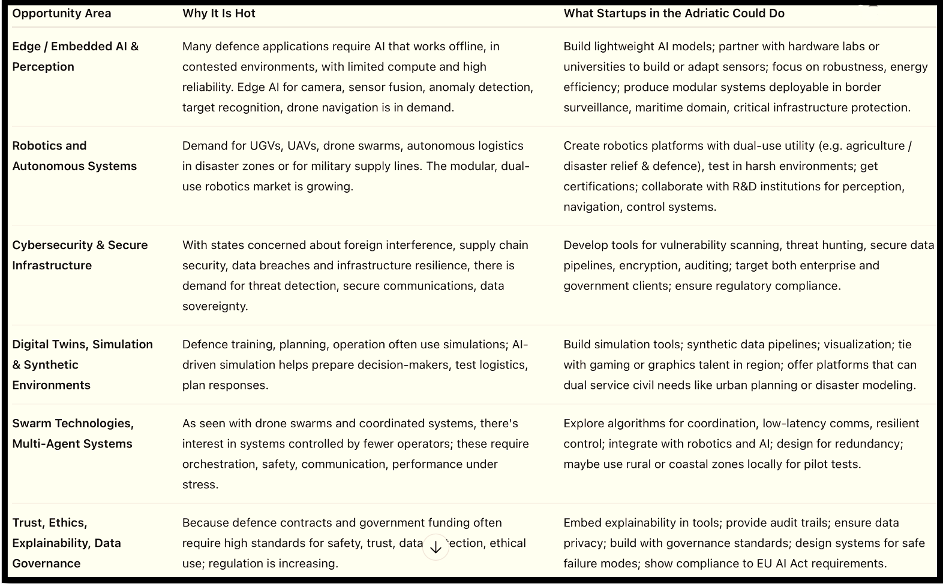
Source: Lemur Legal
Investment Activity & Examples Relevant to the Adriatic Region
To understand how much capital is being deployed, and into what, here are relevant pieces of data and examples:
Europe’s defence-tech sector saw almost a 30% increase in investment in the first half of 2025 with early stage deals making up a large slice.
In the Western Balkans, an EU-backed programme by the European Bank for Reconstruction and Development (EBRD) has allocated €377 million to help SMEs go digital; key focus areas are digitalisation, automation, green tech. That could create space for cybersecurity, robotics, AI to fit in as part of digital infrastructure.
Startup funding in AI in the Western Balkans dropped in 2024 compared to 2023: for example, in 2023 about €33 million was raised, but in 2024 only a few million so far. The specific startups include Collabwriting (Serbia), Lupa Technology (Serbia) among others.
Programmes in Serbia have opened access to funding under EU Digital Europe programme for supercomputing, AI, cloud, cybersecurity, advanced digital skills. This gives local startups visibility and eligibility.
Examples of dual-use tech companies in Europe: ARX Robotics (Germany) which builds unmanned ground vehicles; Blackshark.ai transforming satellite imagery and radio signals; Axelera AI (Netherlands) building AI processing related to robotics, drones, medical devices etc.
These examples show that investors are willing to deploy capital in systems combining hardware + software, that demonstrate dual use, and are at an early stage but with credible roadmaps.
Challenges & Risks for Adriatic Startups
To capture these opportunities, founders in the Adriatic region need to be aware of several challenges. Some are technical, some regulatory, some market-based.
Capital gap and risk tolerance
Dual-use deep tech is expensive in R&D, prototyping, testing. Local capital may be scarcer than in major Western European ecosystems.
Investors often demand proof of concept, field validation, or pilot contracts before committing sizable funds.
Regulatory and compliance burden
EU regulation (AI Act, export controls, data protection) imposes constraints that must be understood early. Dual-use tech often triggers stricter oversight.
Security, privacy, safety, certification requirements can increase timeline and cost.
Access to testbeds, labs, hardware
Building reliable robotics, drone, AI systems typically needs access to sensor labs, robot platforms, outdoor testing ranges, possibly restricted airspaces, secure communications, etc. Adriatic startups may need to partner with universities, research labs, or defence organizations.
Procurement & contracts complexity
Government or defence contracts often have long cycles, opaque requirements, and strict eligibility criteria. Startups may struggle to navigate procurement rules or meet qualification thresholds.
Talent and skill shortages
Although the region has good technical universities and engineering talent, recruiting people with experience in embedded systems, robotics, AI safety, secure hardware, etc., can be hard. Competition with global players may draw talent away.
Market size and scaling
Local markets in the Adriatic are smaller; for products to scale, startups often need to look outward (EU, NATO, export markets). Scaling is not just about tech but about certifications, regulatory alignment, export controls, security clearances.
What Investors are Looking For
Based on current investment patterns and policy priorities, here are what investors demand in dual-use / defence tech:
Clear dual-use proposition Products or services that serve both civilian and military or resilience use cases are more attractive; they reduce risk for investors and governments.
Regulatory & compliance readiness Demonstrated ability to comply with data protection, safety, export regulations, and ethical guidelines. If you can show you are “AI Act ready” or have clean chain of custody for secure data, that helps.
Hardware-software integration Startups that tie together embedded software, robotics/hardware, sensors with software platforms tend to command higher valuations because defence contracts often require end-to-end systems.
Demonstrable use cases / pilots Even small pilots or prototypes in relevant environments matter: whether for government, public safety, infrastructure, emergency response. They provide validation, credibility, risk mitigation.
Edge compute, efficient models, resilience Systems that can work in constrained, contested, or resource‐limited environments: power limits, communications outages, adversarial conditions. Robustness, energy efficiency, redundancy matter.
Trust, transparency and ethical design Investors increasingly want explainable AI, traceability, safety features, secure data pipelines, and good governance. Working on privacy preserving ML, secure enclaves, audit logs etc. is a competitive plus.
International & cross-border readiness Ability to sell or deploy beyond the local market; knowledge of export controls, partnerships with international labs or defence organizations; aligning with EU / NATO standards.
Strategic Steps for Adriatic Founders
To take advantage of the opportunity, founders in the Adriatic region should consider practical strategies to strengthen their position and reduce risk.
Engage early with public funding & EU / NATO programmes
Apply for EDIH hubs, Digital Europe, European Defence Fund, DIANA calls. These programmes may provide not only grants, but also access to pilot opportunities, testbeds, and networks.
Build credibility through strategic partnerships
Universities, national research institutes, defence labs or even local government agencies can provide test grounds, prototyping facilities, and credibility needed for both investors and procurement.
Focus on niche / vertical specialization
Instead of generic AI or robotics, specialize in particular sectors where the region has strategic need or advantage: e.g. border security, maritime surveillance, disaster relief, energy grid resilience, critical infrastructure protection, or environmental monitoring.
Design for robustness, safety, explainability
From early stages think about failure modes, security threats, adversarial settings, privacy. Build for compliance and for governance.
Plan for scaling beyond local markets
Think about export, adaption to regulatory standards elsewhere, and forming partnerships or joint ventures to reach larger defence or security programmes.
Talent development & retention
Invest in hiring or training engineers with expertise in embedded systems, robotics, secure hardware, AI safety, secure communications. Possibly collaborate with universities to build pipelines.
Leverage existing local digitalization programmes
Use SME digitalisation or automation funding to bootstrap parts of your tech stack. Use local grants for cloud infrastructure, AI compute, cybersecurity, when applicable.
Case Scenarios & Hypothetical Use Cases
To bring these ideas into sharper relief, here are a few scenario examples where Adriatic startups could build impactful solutions.
Maritime Border Surveillance Drone + Edge AI
An autonomous or semi-autonomous drone system flying along Adriatic coasts, processing images and sensor data on board to detect illegal fishing, smuggling, or environmental violations. Needs edge AI, robust sensors, resilient communication (possibly mesh or satellite), regulatory approval.
Secure Communication & Data Sovereignty Platform
A system that allows government agencies to share sensitive data across jurisdictions securely. Could include encrypted cloud or edge servers, audit trails, identity verification, possibly zero-trust architectures. Market both civil services and defence customers.
Disaster Response Robotics Swarm
In earthquake, flood, fire situations, deployable robotic units (ground or aerial) that map, search, deliver aid. Dual utility with defence forces (search and rescue), infrastructure agencies, NGOs. AI for perception, autonomy, redundant systems, predictable behavior.
Simulation Sandbox for Training / Planning
A digital twin or synthetic environment for military or government use to model crisis scenarios, train decision-makers, plan logistics. Could also serve urban planning or environmental change modeling. Needs good graphics, scenario scripting, data integration.
Cyber Threat Detection & Incident Response SaaS
A platform offering detection of vulnerabilities, attack surface monitoring, automatically triaging incidents, possibly simulating attacks. Sell to companies first, then government agencies; integrate with national cyber defense requirements.
Conclusion
The future battlefield is digital. For Adriatic startups sensors are aligned, markets are shifting, investors are opening up, and twin pressures of civilian need and defence demand make dual-use technologies more viable than ever. AI, robotics and cybersecurity are especially promising domains.
Success will depend on moving quickly but carefully: aligning with regulation, building proofs and pilots, building trust, and thinking beyond local markets. Founders in Slovenia, Croatia, Serbia, Montenegro, Albania and the wider region who act now can place themselves at the forefront of Europe’s dual-use innovation, helping steer where technologies go, not merely following after them.