
What Is an NFT?
A non-fungible token, or NFT, is a cryptographic token representing a unique digital asset. Each NFT constitutes a unique record of information stored on a blockchain and serves as proof of ownership of a particular digital item or a real-world asset linked to the NFT. An NFT may therefore represent ownership of digital art or another copyright-protected work, a digital identity, real estate or other tangible property. This overview focuses primarily on NFTs connected with digital art and digital collectibles.
Fungibility is a characteristic of certain assets or instruments. For example, one EUR 100 banknote is equivalent to another EUR 100 banknote, meaning that the two are fully interchangeable or fungible. A university diploma, by contrast, is not identical to another diploma. Each diploma relates to a particular person and qualification, making the two non-fungible.
Physical trading cards associated with sports clubs and athletes were once extremely popular. These collections were usually issued in limited quantities. The rarer a particular card was, the more valuable it could become. Its value could also depend on its serial number. For example, if 1,000 commemorative cards were issued, a card numbered 1/1000 would generally be more valuable than one numbered 500/1000.
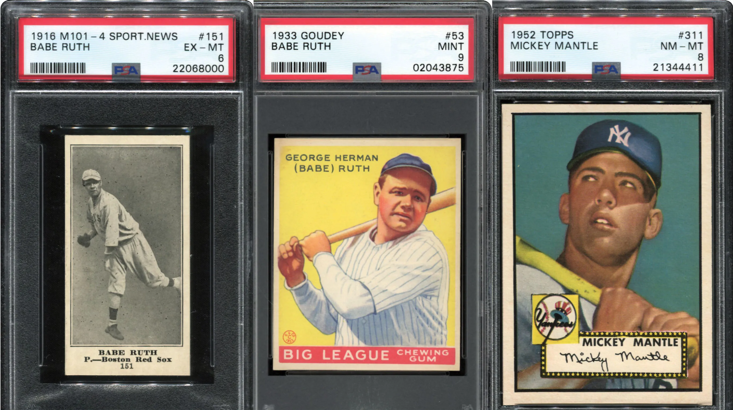
In one of its forms, an NFT is the digital equivalent of this type of physical trading card. By purchasing an NFT, a person acquires ownership of a particular digital creation, such as a digital artwork, or ownership of a real-world asset where the NFT is linked to tangible property, such as real estate. An issuer may, for example, create a series of 10,000 NFTs containing images, videos or animations in formats such as JPG, MP4 or GIF. Each NFT is assigned its own serial number.
NFTs are issued using blockchain technology, which prevents so-called double spending. One of the principal challenges of digital records is that a copy of a document, photograph or audio recording may be identical to the original, regardless of how many copies are made. When information such as ownership of a house or digital money is transferred digitally, there must therefore be a mechanism preventing the same owner from transferring it to several different recipients. In the physical world, systems such as land registers perform this function. Blockchain technology addresses the same problem in the digital environment by enabling information to be transferred without permitting unauthorised duplication of the ownership record.
Issuing an NFT on a blockchain and providing its holder with proof of ownership of a particular digital creation creates scarcity. Scarcity is also a central factor in determining the value of traditional artworks.
What Can an NFT Contain?
NFTs differ both in their content and in the rights attached to their ownership. They may contain video, audio and various other forms of content.
NFTs may be static or dynamic. Static NFTs generally consist of digitised artworks without animation and may be issued in formats such as JPG, PNG or PDF. Dynamic NFTs use formats that support animation, video or audio, including MP4, GIF, MP3 and WAV. Many NFTs have historically been issued in JPEG or GIF format, although the NFT industry has increasingly moved towards dynamic NFTs.
Specific rights may also be attached to NFT ownership. An NFT may grant its holder exclusive access to particular content or early access before it becomes available to the broader community. These are sometimes referred to as access NFTs.
Some NFTs, particularly those connected with decentralised autonomous organisations, allow their holders to participate in decisions concerning a community. In such cases, the NFT may serve as the basis for voting or governance rights and is often described as a governance NFT.
Another common right associated with NFTs is the right to receive a share of the proceeds from subsequent sales. These payments are generally referred to as NFT royalties.
Why Own an NFT?
Ownership of an NFT may serve as proof that a person owns a particular digital creation, similarly to the ownership of a physical artwork. Digital galleries also allow NFT holders to display their collections online. One example is Lazy.
For collectors and committed members of communities built around particular NFT projects, ownership itself may be the primary motivation for purchasing an NFT.
Where an NFT grants additional rights, such as exclusive access to content or voting rights, these benefits may motivate the most active members of the relevant community to acquire and retain it.
NFTs have also been sold for millions of US dollars. Their purchase may therefore be speculative, and the possibility of future price appreciation is likely to be an important motivation for a significant proportion of NFT buyers.
Why Issue an NFT?
The motivation for issuing an NFT differs from the motivation for purchasing one and depends largely on the identity and objectives of the issuer.
Corporate Motivation
Large international companies such as PepsiCo, Nike and Adidas have issued NFT collections to strengthen their brands and demonstrate to customers that they are keeping pace with technological and cultural developments.
Digital Art and Passive Income
Where an NFT is linked to digital art, the initial issuance provides a method of selling the relevant artwork. The issuer earns revenue from the initial sale and may distribute that revenue among several stakeholders. A rule may also be incorporated into the underlying software code entitling the issuer or creator to a percentage of the proceeds from every subsequent sale.
NFTs are based on smart contracts. A smart contract is self-executing software code containing predetermined rules that are automatically carried out when specified conditions are met. Smart contracts can therefore determine how revenue is distributed both during the initial issuance of an NFT and during secondary trading between subsequent holders.
For example, the creator of a musical work and a music agency may divide the proceeds from the initial issuance in an 80:20 ratio. For every subsequent sale of the NFT, the creator may receive 2% of the transaction value and the agency 1%.
These payments can be processed automatically without manual intervention. The recipient, such as the creator, has a cryptocurrency wallet into which revenue is transferred whenever the NFT changes hands. Payments may be made in cryptocurrencies such as Ether or Solana. In this way, NFTs may create an ongoing source of passive income for creators, issuers and other stakeholders.
Digital Ecosystems
Parallel digital worlds have been developing for some time. Second Life began emerging in 2003, while Decentraland and The Sandbox are more recent examples. Epic Games has also developed an extensive digital environment through Fortnite.
These and similar digital ecosystems are often described collectively as the metaverse. Cryptocurrencies and NFTs may serve as fundamental building blocks within them. NFTs can be linked to specific assets located inside these ecosystems. For example, ownership of a virtual building in Decentraland may be represented through an NFT linked to that property.
During one week in December 2021, approximately USD 106 million worth of virtual real estate was reportedly purchased across four metaverse platforms.
Buying an NFT
Major platforms used for issuing and trading NFTs have included Nifty Gateway, SuperRare, Rarible, OpenSea, Coinbase and Solanart. Other platforms, such as NBA Top Shot, issue their own specialised NFT collections.
Many NFT marketplaces operate through decentralised infrastructure. Users may therefore need a certain degree of technical knowledge to create a cryptocurrency wallet, connect it to a platform and complete purchases and sales. Historically, this has resulted in a user experience that was not particularly accessible to the general public.
As centralised cryptocurrency exchanges such as Binance and Coinbase began launching their own NFT marketplaces, the purchasing process became more similar to an ordinary online transaction and consequently more user-friendly.
Examples of NFT Collections and Their Values
CryptoPunks
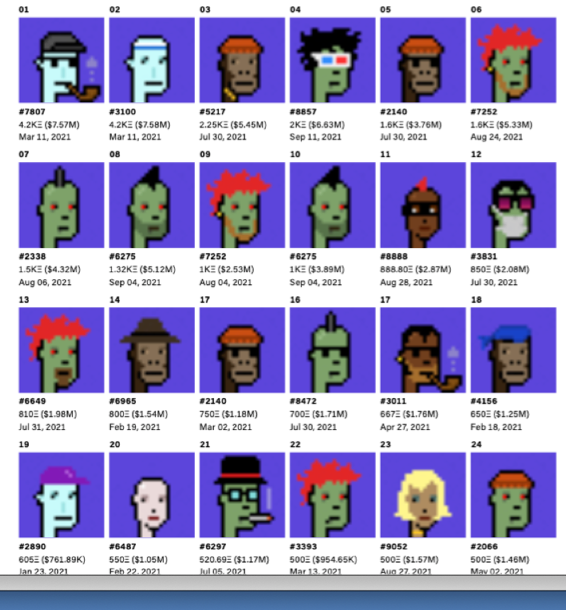
CryptoPunks is a collection of 10,000 NFTs issued in 2017. Individual NFTs in the collection were sold for prices ranging from approximately USD 1.5 million to USD 7.6 million. In August 2021, transactions between CryptoPunks holders reportedly reached USD 143 million in a single day.
The NFTs were initially distributed free of charge, while revenue was later generated through secondary trading between holders.
CryptoKitties
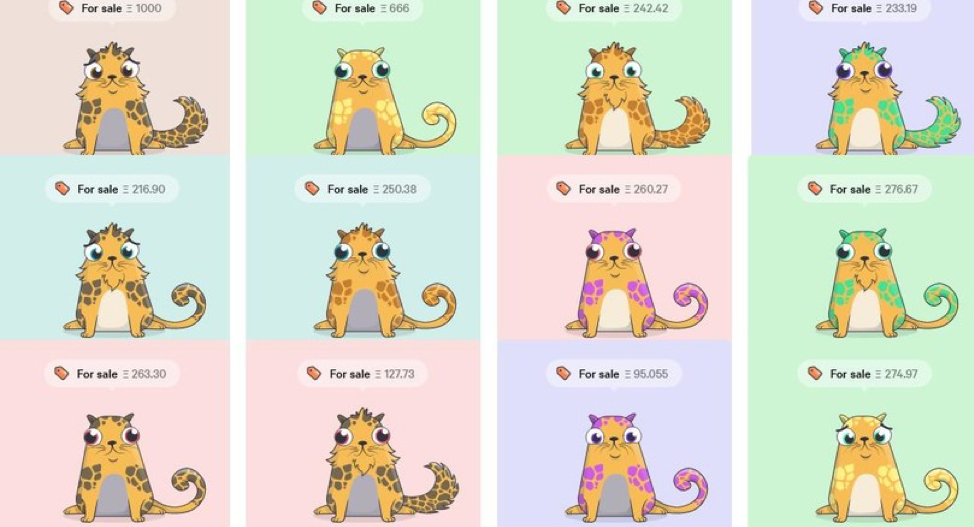
CryptoKitties was also launched in 2017. One of the highest recorded prices for an individual digital cat was approximately USD 172,000, equivalent at the time to 600 ETH.
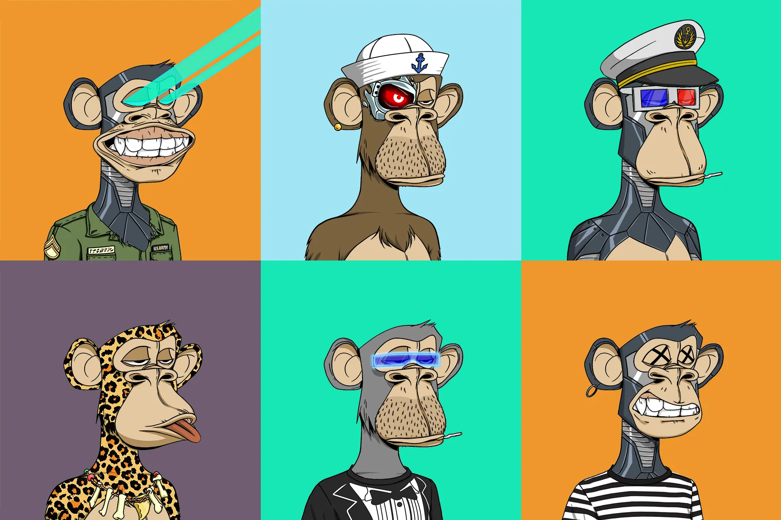
Bored Ape Yacht Club
Bored Ape Yacht Club issued a collection of 10,000 NFTs. In September 2021, one NFT from the collection sold for approximately USD 2.9 million. In October of the same year, a rare ape with golden fur—an attribute found in fewer than 1% of the collection—reportedly sold for approximately USD 3.4 million.
Club website: Bored Ape Yacht Club
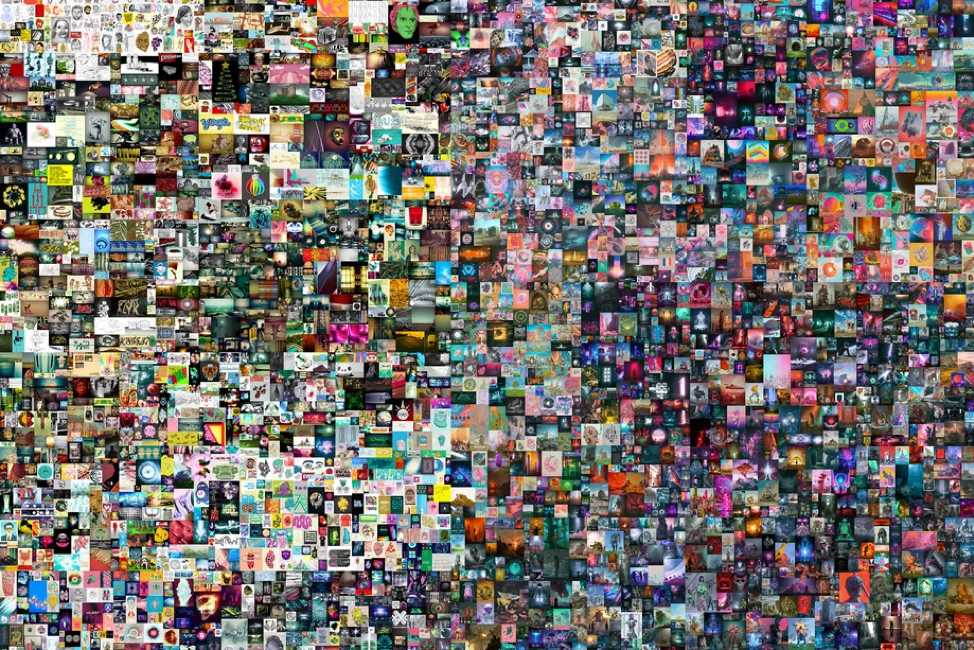
Beeple
In March 2021, the artist Beeple sold a static NFT consisting of a collage of 5,000 digital images created over 5,000 consecutive days. The work sold for approximately USD 69 million.
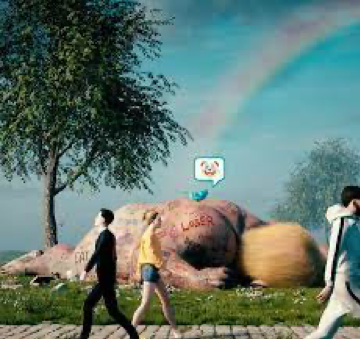
A dynamic NFT by Beeple was reportedly sold in February 2021 for approximately USD 6.6 million.
View the NFT: Beeple’s CROSSROAD
Other Examples of NFT Issuances
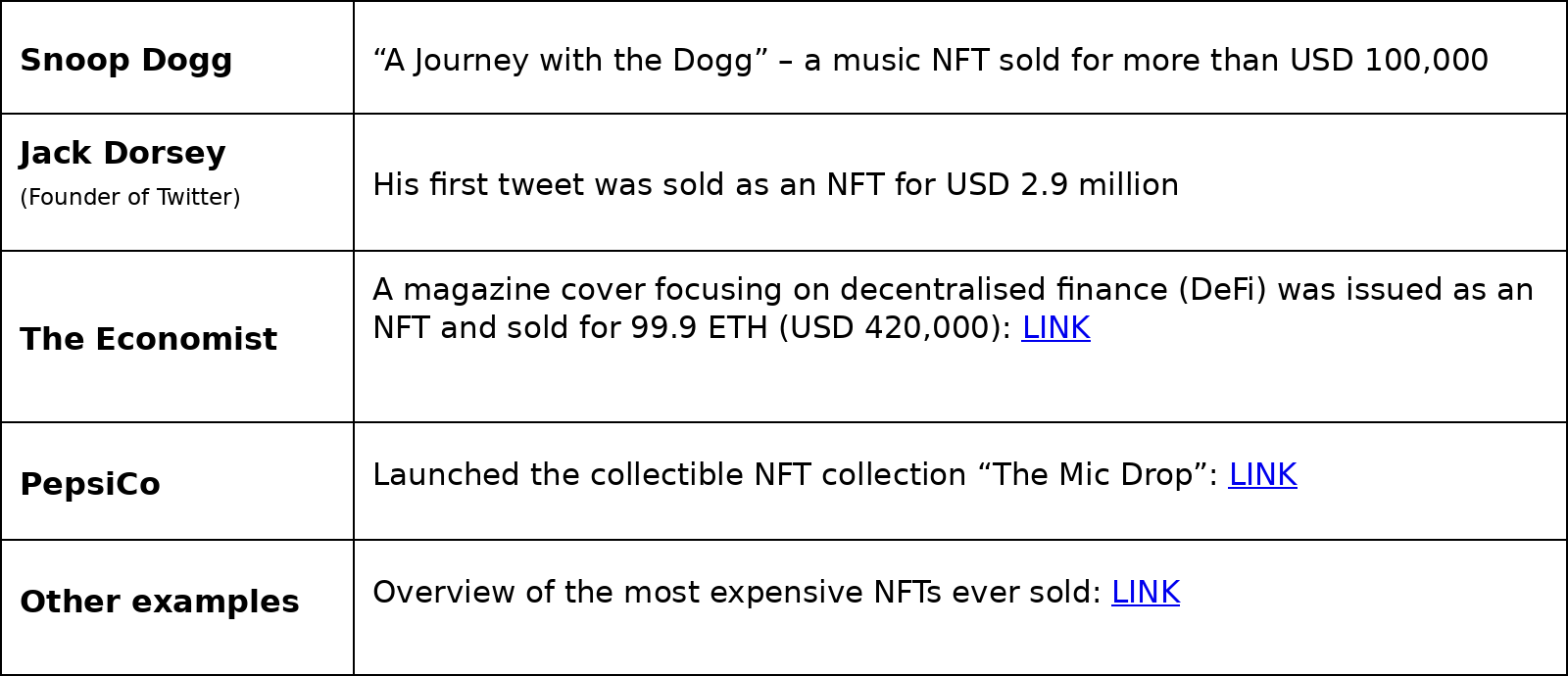
Numerous other artists, companies, sports organisations and digital communities have issued NFT collections in different formats and with different ownership rights, utilities and commercial models.
NFT Market Size and Prices
NFT sales totalled approximately USD 56 million in 2020 and reportedly exceeded USD 972 million during the first half of 2021, representing substantial year-on-year growth.
NFT prices range from a few US dollars to tens of millions. The price of an individual NFT depends on the number of tokens issued with the same or related content, the rarity of the item and, most importantly, the level of market interest.
Digital collectibles represented one of the largest NFT market segments in 2021, with an estimated market value of USD 3.7 billion, followed by gaming-related NFTs and digital art.
Among the most commercially successful NFT artists at the time were Beeple, Pak, FEWOCiOUS, Trevor Jones, XCOPY and Mad Dog Jones.